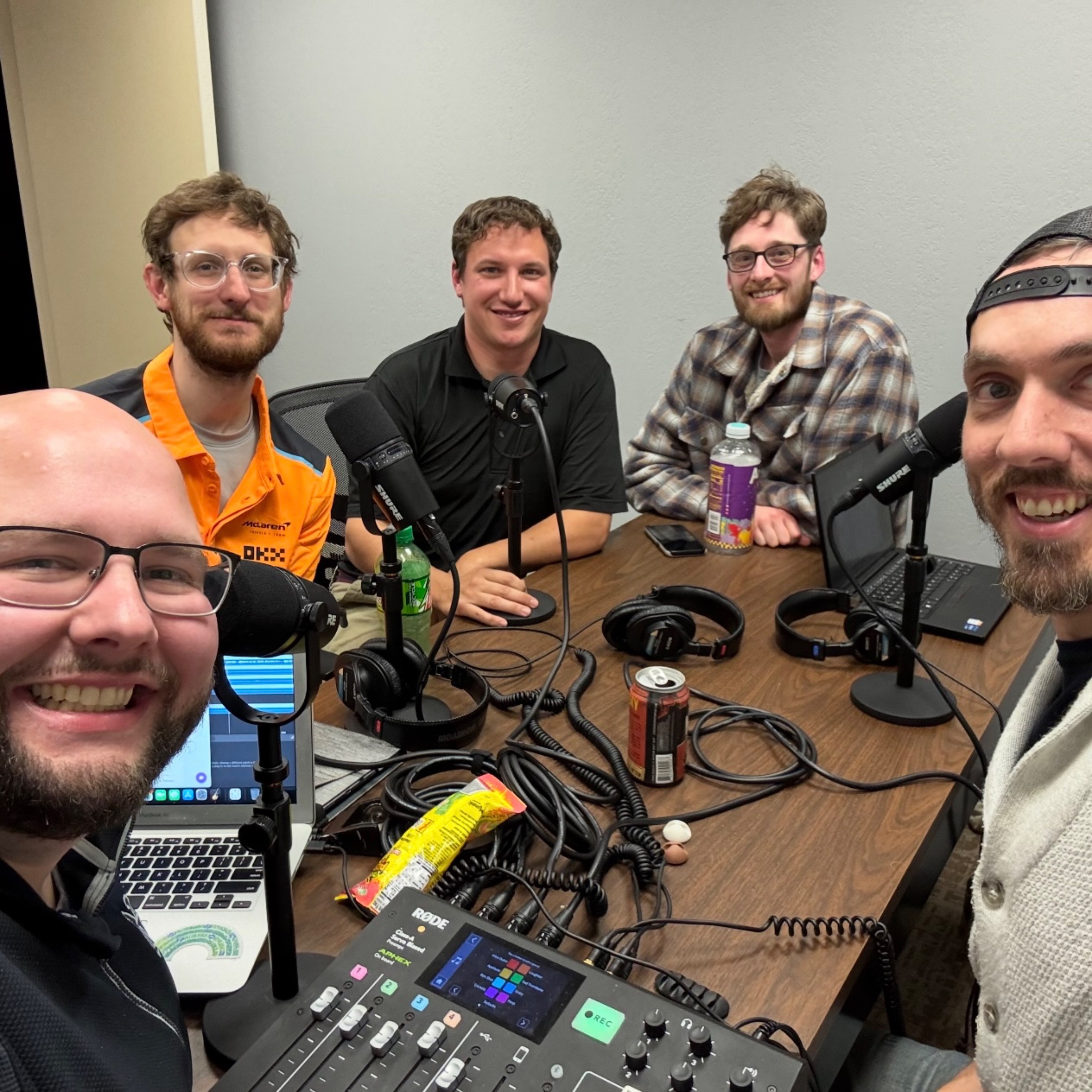
Episode Transcript
[00:00:00] Speaker A: Nerdy, nerdy, nerdy, nerdy, nerdy, nerdy, nerdy, nerdy.
[00:00:02] Speaker B: Make it.
Make it.
We're not redoing it.
[00:00:10] Speaker A: It's our fourth time.
[00:00:11] Speaker B: Guys. Welcome to the make it Nerdy. We tried a little bit of our songs to start. Batman, I guess, is not the strong, strong suit of our group.
[00:00:19] Speaker C: Well, you know, we tried.
[00:00:21] Speaker A: Maybe we'll hear more about that later. Foreshadowing.
[00:00:23] Speaker C: Holy guacamole there, Batman.
[00:00:26] Speaker B: Bam.
[00:00:27] Speaker D: Wow.
[00:00:27] Speaker E: Pow.
[00:00:28] Speaker D: Classic.
[00:00:29] Speaker C: Who's the best Batman? Is that a whole episode in it of Kevin Conroy?
[00:00:33] Speaker A: Oh, we could do a whole Batman episode. We've done a whole Star wars episode.
[00:00:37] Speaker E: We have.
[00:00:37] Speaker C: We have.
[00:00:38] Speaker E: That ain't George Clooney.
[00:00:41] Speaker A: Indisputable.
We're supposed to bring hot takes today.
[00:00:45] Speaker D: Anthony.
[00:00:46] Speaker C: I love the nipples. That's for sure.
[00:00:50] Speaker A: He's got.
[00:00:51] Speaker C: Don't give me that look. What makes George Clooney Batman iconic is the suit. It's got nipples.
[00:00:58] Speaker D: Mm.
[00:00:59] Speaker C: It's weird.
[00:01:00] Speaker B: Okay, you heard it here first, guys.
[00:01:02] Speaker C: I mean, come on, guys. It's got nipples.
[00:01:08] Speaker B: Well, today we're going to start our podcast episode is going to be all about hot takes. So we're going to give some really unpopular. Some people are going to call it unpopular. Mine are very popular in my own head. Okay. Takes that. It's potentially going to start some arguments. So we need to lay some ground rules out. We are all friends except for Thane and.
I'm kidding.
[00:01:29] Speaker E: Hold on, hold on.
[00:01:30] Speaker B: I'm kidding.
[00:01:32] Speaker A: Brutal.
[00:01:32] Speaker D: Hot.
[00:01:33] Speaker A: I actually. I actually have, like a. Some. A prayer. Oh, that we could.
[00:01:37] Speaker B: Go ahead.
[00:01:38] Speaker A: That we could say. You guys can hold hands if you want to, but we'll just. We'll just have a moment of silence.
[00:01:42] Speaker E: Bring it in, Ian.
[00:01:43] Speaker C: Okay, I'm holding a microphone.
[00:01:46] Speaker A: Dear father in heaven, today we implore you and beg your mercy and your grace as we five young white guys with microphones fulfill our sacred obligation to create podcasts for our other friends to listen to. We ask your blessing to come down upon this studio on this day. It has been ordained that many deranged and uncouth words shall be exchanged.
It is our duty now to sacrifice our own reputations in service of creating content for others praise.
They don't know yet what will be said. During this episode, listeners may be subjected to outrageous opinions.
Like any claim that Logan is not the greatest superhero movie of all time.
For these and any other outlandish statements, we beg your forgiveness. And to our listeners as well, we do this all in service to you. We ask your grace, Lord, that Each of us also will be able to look past the senseless vitriol and remember that we are still friends.
[00:02:47] Speaker B: In. With your spirit.
[00:02:48] Speaker A: In Jesus name we pray.
[00:02:50] Speaker D: Amen.
[00:02:50] Speaker B: Amen.
[00:02:51] Speaker C: I don't know what I was going with.
[00:02:53] Speaker D: Christ.
[00:02:54] Speaker A: Thank you, though.
[00:02:55] Speaker B: And also with you. Yeah.
[00:02:57] Speaker A: And with your spirit.
[00:02:58] Speaker C: Yeah.
[00:02:58] Speaker D: May the force be with me.
[00:03:03] Speaker A: All right, are we ready for this?
[00:03:05] Speaker B: F is secretly kind of one of one of our funniest members of the pod, where it just throws out, like, you. Just the random things that are, like four hours. You're like, that was pretty good.
[00:03:14] Speaker D: All right.
[00:03:15] Speaker A: I'm funny without keeping it secret, so. Yeah.
[00:03:17] Speaker B: Yeah.
And you're humble. Let's move on to our hot takes, people.
We got some mailbag.
[00:03:24] Speaker C: Oh, yeah, yeah, yeah.
[00:03:25] Speaker B: Let's hear from some of our listeners. Some of our ear listeners got some things they want to say. Some of them are hot takes, Some not so much. Some are just some mailbag questions.
[00:03:32] Speaker A: What do you got for us, mailbag? I'm going first to the commish we know from our other episode, Adam Silver, the Adam Silver, the one you're thinking of, wrote into this show specifically to give us five takes that he wants to get off his chest.
[00:03:46] Speaker C: I love takes.
[00:03:47] Speaker B: Thank you.
[00:03:49] Speaker A: Number one, trail running is better than road running.
[00:03:54] Speaker B: I'm a more of a wiley coyote myself.
[00:03:56] Speaker A: I'm pro trail. I like the trail. I like the up.
[00:03:59] Speaker C: Well, he lives in California, though, doesn't he?
[00:04:00] Speaker A: He lives in North Carolina now.
[00:04:02] Speaker B: Oh, pretty close.
[00:04:05] Speaker C: Hold on.
[00:04:07] Speaker A: He relocated to the East coast, like, 10 years ago.
[00:04:10] Speaker B: 10 years.
[00:04:10] Speaker C: 10 years.
[00:04:10] Speaker B: Yeah. It's been a while.
[00:04:11] Speaker C: He's a Niners fan.
[00:04:13] Speaker A: He grew up in the Bay and then lived in la.
[00:04:16] Speaker C: I figured he was. I just assumed.
[00:04:18] Speaker E: All right.
[00:04:18] Speaker C: Things I'm learning. I don't text you, Adam, very often, by which I mean I ever send him a text. Yeah, send me a text.
[00:04:26] Speaker A: Do you think you should become a Panthers fan instead? He's in North Carolina.
[00:04:29] Speaker B: Bryce Young.
[00:04:29] Speaker C: Bryce Young, baby.
[00:04:30] Speaker A: Take number two. People who ask what's best price on your Facebook marketplace item expecting you to compete with yourself are lame.
[00:04:38] Speaker C: Yeah.
[00:04:39] Speaker D: Okay. All right.
[00:04:40] Speaker A: I think we all agree.
[00:04:41] Speaker B: Can I tell you a little one liner that I use when I, like, am selling, like, a card? Like, started recently doing cards and going to card shows, and they'll say like, well, what do you want on that? And I'll go, I can't sell it and buy it at the same time.
[00:04:56] Speaker D: Oh, no.
[00:04:56] Speaker B: And that gets people, like, they. People love that line. They're like, oh, five Bucks off. And I'm like, great.
[00:05:03] Speaker C: Did you, like, Google search that line before?
[00:05:05] Speaker B: No, I'm just like, I think I found it on, like, I don't know, probably. My algorithm was just showing me a bunch of people doing it. Can't sell it and buy it at the same time. And if you got. If you say it as a jerk, it does not come out, like, right. I can't sell it and buy it at the same time.
We're running into dangerous territory.
[00:05:22] Speaker E: Did you do that one?
[00:05:23] Speaker B: No. Yeah, I did it once. Did you try that version? Did it once. Didn't go over well, but he warranted it most of the time.
[00:05:29] Speaker C: It works out pretty well, though.
[00:05:31] Speaker A: Yeah. People are pretty. People suck on Facebook Marketplace.
[00:05:34] Speaker B: Yeah, Facebook Marketplace is, like, the closest thing we have to, like, the Hunger Games in real life. Like, it's just where people go to die.
[00:05:39] Speaker C: It is janky.
Anytime we've had to buy or sell anything on Facebook, Marketplace, Claire's like, oh, just go pick it up. I'm like, God, no.
[00:05:47] Speaker E: God, no.
[00:05:48] Speaker C: I'm going to get it, or I'm gonna be the one to drop it off.
[00:05:51] Speaker A: Right.
[00:05:52] Speaker C: Have, like, no.
[00:05:54] Speaker A: Number three for madam. People who dump dogs or abuse animals are evil.
[00:05:57] Speaker E: Okay.
[00:05:58] Speaker A: All right, all right. That's not number four. Ben and Jerry's fish food. That's P H, I, S H. Fish food might be the best mixture of ice cream ever.
[00:06:07] Speaker D: Cherry Garcia fish food is pretty good.
[00:06:11] Speaker A: I've never.
[00:06:12] Speaker B: Tonight.
[00:06:12] Speaker A: That's.
[00:06:12] Speaker B: Actually.
[00:06:13] Speaker A: I've never had it.
[00:06:14] Speaker D: It's just chocolate goodness, but it has, like, little, you know, like. Like goldfish shaped like little fish. It's the same, but chocolate.
But chocolate. And it's. It's vanilla ice cream, and it's caramel.
[00:06:28] Speaker B: Right?
[00:06:28] Speaker D: It's really good caramel. And I. I really like it. It's. But actually, Ben and Jerry's, for me, is too much stuff happening. Typically.
[00:06:40] Speaker C: This was a question I was gonna ask.
[00:06:41] Speaker B: You did strike me as vanilla.
[00:06:43] Speaker A: I'm a little more pro Vanilla based.
[00:06:46] Speaker B: You looked right down the road from
[00:06:47] Speaker E: the parlor, about to go defend your honor thing.
[00:06:53] Speaker D: I just want.
[00:06:53] Speaker E: He just called you vanilla.
[00:06:55] Speaker D: I want ice cream, but I sometimes don't want to, like, chew it. You know what I'm saying?
[00:06:59] Speaker E: I. I hear you. Yeah.
[00:07:00] Speaker A: All right, I'm done.
[00:07:00] Speaker C: I feel like.
[00:07:01] Speaker B: So you're like a gummy bear guy in the ice cream?
[00:07:03] Speaker D: No, the opposite.
[00:07:04] Speaker C: I feel like Ben and Jerry's, but so vanilla. I feel like.
[00:07:10] Speaker B: I'm kidding.
[00:07:11] Speaker A: Say what you're gonna say.
[00:07:12] Speaker C: I'm Trying to say your piece. I feel like Jerry's has a lot flavors and a lot of, like, different concoctions that are all basically just different versions of the same thing.
[00:07:23] Speaker D: A little bit.
[00:07:24] Speaker E: Yeah.
[00:07:24] Speaker D: Well, yeah, I mean.
[00:07:27] Speaker A: Okay.
[00:07:27] Speaker D: We could say the same thing about lots of stuff.
[00:07:30] Speaker B: Burgers.
Thank you.
[00:07:34] Speaker A: Yeah, we could say the same thing about Sean McVeigh's offensive scheme. So, you know, like, can we.
[00:07:40] Speaker B: Yeah.
[00:07:41] Speaker A: Okay. Number five.
[00:07:43] Speaker B: I don't know. I guess we'll figure it out in the point after.
[00:07:45] Speaker C: I don't even know.
[00:07:46] Speaker A: Stouts and porters are better than IPAs. That's number five.
[00:07:50] Speaker B: You guys can reply to that.
[00:07:54] Speaker A: I'm not gonna. I'm not gonna be on. On board with that fully. Although I like them all.
[00:07:58] Speaker D: I'm typically an IPA guy. I'm drinking one.
[00:08:02] Speaker A: So am I. Cheers.
[00:08:03] Speaker D: Cheers. Cheers.
[00:08:04] Speaker B: Liquid death.
[00:08:04] Speaker A: There we go.
[00:08:05] Speaker B: Cheers. All right.
[00:08:06] Speaker A: Yeah. Cheers.
[00:08:07] Speaker C: American do.
[00:08:08] Speaker A: Those are the takes from our dear listener Adam.
[00:08:11] Speaker B: Thank you, commission.
[00:08:12] Speaker E: I got you.
[00:08:13] Speaker B: We didn't have the sounder ready for you this time, but I appreciate your takes, as always.
We have kind of a listener does that has a hot take. Am I right or wrong on that? Kyle, does Rick have any hot takes?
[00:08:27] Speaker A: Amongst those, our good friend Rick. Rick has written into the show, and he sent me a good selection of questions, and we kind of high. We highlighted our favorites. And so I'm going to. I'm going to pluck some of these. These are more on topic for this show. These relate to the nerdy stuff that we cover on this particular program.
So I'm going to run through these. Our responses can be brief and concise. If we choose, we probably won't.
The first take from Rick, the multiverse.
[00:09:02] Speaker C: Okay,
[00:09:06] Speaker D: I'm out.
[00:09:08] Speaker B: Okay.
[00:09:09] Speaker A: The multiverse is a storytelling cheat code. It gives writers endless options while making death stakes and consequences feel temporary.
[00:09:16] Speaker C: That's not hot.
[00:09:17] Speaker E: No, not a hot take.
[00:09:18] Speaker A: 100% agree, Mr.
[00:09:20] Speaker C: Freeze type of take.
[00:09:23] Speaker A: Oh, man. Rick, you've been called out, man.
[00:09:26] Speaker D: So cold. It's hot.
[00:09:28] Speaker C: I think that's been one of the major complaints of the mcu is it's like fatigue of like. Okay, here we go again.
[00:09:34] Speaker A: Here's another scene.
[00:09:36] Speaker D: Absolutely. It makes it feel.
[00:09:37] Speaker C: Oh, man. You're gonna bring this. You're gonna bring Captain back for Doomsday. How are they gonna do.
[00:09:43] Speaker A: Of course, here comes Loki again after he died. Yes. I hate that deaths mean nothing. I hate that. It's so dumb. Anytime somebody dies in a new movie, I'm just like, whatever, you're coming back.
[00:09:54] Speaker D: Yeah.
[00:09:55] Speaker A: I mean, if that character polls well for you, you'll write the character back in.
[00:10:00] Speaker D: Yeah, right.
[00:10:02] Speaker A: Dumb. Okay, next. Cutting Tom Bombadil from the Lord of the Rings was the right choice because adaptation is not transcription.
That's a perspective.
[00:10:12] Speaker B: I just think his tone would have thrown off the whole movie. Like, he just. It's such a.
[00:10:18] Speaker E: You would have had to do a lot more lore building.
[00:10:21] Speaker C: You know, there's an argument to be made that the book is more about Frodo and Tom Bombadil and the journey through the Barrows is a big portion of like that growth story for Frodo.
But the movies are about Aragorn.
[00:10:38] Speaker A: Oh, yeah.
[00:10:39] Speaker C: And that he is more of the centrally main protagonist of the actual movie more than Frodo is.
[00:10:47] Speaker A: Okay.
[00:10:48] Speaker C: It's an interesting take, I've heard.
[00:10:49] Speaker A: Yeah.
[00:10:50] Speaker D: I don't know. I mean, Aragorn doesn't change all that much.
[00:10:54] Speaker E: He's.
[00:10:55] Speaker D: He. He remains pretty static. Like, his. His choices, his morals, his. Everything about him kind of remains the same.
[00:11:06] Speaker A: What I. What I would say to that point, though, in the books, I think he actually changes less. He's still who he. In the movies, they wrote him to be experiencing a little more anguish over his role and future and embracing the.
The ruler role and then his inheritance of source of.
[00:11:30] Speaker C: Very clearly in the movie Return of the King is referencing him.
[00:11:34] Speaker D: Yes.
[00:11:34] Speaker C: But the book, it's not like that. It's more about Frodo going back because there was a whole thing.
[00:11:42] Speaker A: It is, it is.
[00:11:42] Speaker C: And I actually.
[00:11:43] Speaker A: But the Peter Jackson movies kind of really invented this whole, like, I don't want to be the king sort of thing and. No. All right. I accept it at the end. He wasn't really like that in the books. Correct.
[00:11:53] Speaker C: Which is why I'm saying, like, I actually don't hate the take of. Why the movies are more geared towards him.
[00:11:59] Speaker A: Yeah.
[00:11:59] Speaker C: Because in the book they also left out where the Shire is like, completely.
[00:12:05] Speaker E: That was cool because I like, overtaken
[00:12:07] Speaker C: and on fire and then they have to go back over there.
[00:12:10] Speaker E: I liked watching Mary and Pippen, like, and Sam all rise up and rise up.
[00:12:15] Speaker A: Right.
[00:12:16] Speaker E: And be awesome.
[00:12:17] Speaker A: Prince Emrahil was a really big character in the books as well. That was written out for the movie. And that's fine. I think to Rick's point, like, you have to make. You don't really need to like, line for line copy a book on screen in order for it to be.
[00:12:33] Speaker E: And it's definitely better than going half into the story and then going, we ran out of time.
[00:12:39] Speaker C: I feel like Monty Python there.
[00:12:42] Speaker E: Spider man. Three Amazing Spider Man.
[00:12:44] Speaker C: Well, and then. I mean, yeah, some books, it's really hard, especially when you're doing, like, book adaptations, to get everything in there correct. Harry Potter had the same problems.
It was like the fifth movie, the book was huge. Yeah, totally. And they had so much like. What was the name of that whole group?
[00:13:00] Speaker D: The Order of the Phoenix.
[00:13:01] Speaker E: Order of Phoenix.
[00:13:02] Speaker C: No, no, no. Not Order of the Phoenix and not Dumbledore's Army. It was the thing that Hermione made up.
[00:13:08] Speaker A: Oh, what are you talking about?
[00:13:09] Speaker D: For the.
[00:13:09] Speaker C: For, like, the. The.
[00:13:11] Speaker E: For the elves.
[00:13:11] Speaker C: The elves.
[00:13:13] Speaker D: Oh, yeah.
[00:13:14] Speaker C: That whole thing was not even in the book or the movie.
[00:13:20] Speaker A: Oh, gosh. I don't remember that.
[00:13:22] Speaker E: She was campaigning.
[00:13:23] Speaker A: Yes.
[00:13:26] Speaker C: It was a much bigger deal when they became prefects and he did not. And he was like, nothing. It was like a huge.
Like, the book really was more about his angst and they really, like, cut
[00:13:38] Speaker B: a lot of that.
[00:13:39] Speaker D: Oh. In the fourth movie when they just, like, the World cup stuff just.
[00:13:44] Speaker C: Oh, God, that was over just like.
[00:13:47] Speaker D: And the game began and then done and like, we're.
[00:13:50] Speaker C: The book scene, like, the sequence was awesome.
[00:13:52] Speaker E: Yeah.
[00:13:53] Speaker D: Yeah.
[00:13:53] Speaker C: It was so cool.
[00:13:54] Speaker D: Yeah, it's awesome.
[00:13:55] Speaker A: Yeah, that's true. There's a lot more Quidditch.
[00:13:57] Speaker D: Yeah.
[00:13:58] Speaker C: There's just examples of a very similar thing, is.
[00:14:00] Speaker B: All right.
[00:14:01] Speaker A: Yeah. I forgot what we were talking about at this point. But the next one.
Yeah, we're wandering here.
The next one from Rick. Not every villain needs to be understood. Evil is not always more interesting when you explain it. Sometimes the mystery is the point.
I feel about that.
[00:14:19] Speaker C: It depends.
Like, Sauron is a really good example.
[00:14:23] Speaker E: I feel like. Yeah, it's not hit.
I agree with it, but it's not hit very well lately.
Yeah.
[00:14:29] Speaker C: Sauron, especially in the movies, is a very good.
I like, example of, like, he's just bad.
Just evil.
[00:14:38] Speaker D: Right.
[00:14:38] Speaker E: All right.
[00:14:38] Speaker C: And there's not a lot of backstory about who Sauron is, just.
And then, you know, because he's supposed to represent, you know, evil.
[00:14:46] Speaker B: Just evil.
[00:14:47] Speaker D: Right.
[00:14:47] Speaker A: I. And to that point, like, I actually think they could have done with more mystery in the films, like, on screen. I think the physical manifestations of the Sauron character don't do justice to the. That character in the. In the stories. Like, I actually. I. The first. Even the first time I saw it every time, since it might be. The thing that I hate most in those movies is Sauron on top of Baradura is just like a flaming eye who's like this lighthouse character, like spotlighting all around. I always find that cartoonish and stupid every time. It is like a very poor representation of the, the essence of Sauron that existed and the, the Tower of Baradur.
[00:15:27] Speaker C: But Frodo's flop in the movie.
[00:15:31] Speaker D: That's great.
Okay.
[00:15:33] Speaker A: I, I, I genuinely don't like that and I think like it could have been done with more mystery and less of like this very physical representation.
[00:15:40] Speaker C: Only thing I will say is this is related to one of my takes as well.
[00:15:44] Speaker B: Okay, yeah, let's hold on to that.
[00:15:46] Speaker A: This is, this one I find hard to paint with a broad brush and say just like. Because I do think that sometimes like the stories are very much enhanced by a richer story. And I think a lot of superhero movies are underdevelop their villains.
And like I can think of a few that were well developed like Loki and Athanos and stuff like that were like, okay, they did a pretty good job of establishing, developing the character and you're invested in the story and it's meaningful. And there's more, there's more examples where they underdeveloped the and it's like this could be a good villain but you just like, like fast tracked it to just another more powerful than the last time Bad guy.
[00:16:20] Speaker C: Some of it is on screen.
The quite frankly it comes down to the charisma of the actor and how well they are at portraying that character. Thanos, quite honestly, not a lot of backstory if you really think about it.
[00:16:35] Speaker A: But it didn't even always backstory.
[00:16:37] Speaker C: They show him though. Yeah, but they give you especially in Endgame or not Endgame. Infinity wars. More sequences with him where you just see him being him.
[00:16:48] Speaker B: Yes.
[00:16:48] Speaker C: And super intimidating and very threatening. You can see every scene that he's in, his like presence is felt.
[00:16:57] Speaker A: Oh yeah.
[00:16:57] Speaker C: Like it's like boom, he's right there.
[00:17:00] Speaker A: Yeah. There's no question.
[00:17:01] Speaker B: But there's very few movies that have a villain in a singular movie that it's has the chance to have some character development of a villain that does not happen. I can think of one example that will be on my honorable mention list that you can hear at the end of this episode.
[00:17:20] Speaker A: My favorite is Willem Dafoe descending sending into madness in as Green Goblin. I hope that wasn't your no example, but I think one movie and that was well developed villain.
[00:17:32] Speaker E: But and then I agree with Marshall's point where I mean we got hints of Thanos's build up and power.
[00:17:39] Speaker B: Even people that don't know comics know Thanos.
[00:17:42] Speaker E: Right.
[00:17:43] Speaker B: Like, everyone knew who Thanos was when he showed up in the first one.
[00:17:46] Speaker C: You could also argue that one of the best on film adaptations of a bad guy. You barely seen the entire movie, and it's a shark.
[00:17:55] Speaker A: Oh, yeah. Fantastic. 100%.
[00:17:59] Speaker D: Yeah.
[00:18:00] Speaker C: Like an iconic villain in all retrospect. And all you really have is
[00:18:07] Speaker A: that movie is better because you see less of the shark. And I think that maybe there's, like, a difference here between, like, a sentient villain, then maybe that's the wrong word, but then a monster.
Because I often find that the monsters, like, those are better to show less.
[00:18:27] Speaker B: Yeah.
[00:18:28] Speaker A: Because there's just. As soon as you show them, like, there's nothing more to do. Yeah. It's way better to just, like, leave the mystery and the fear and build it up.
[00:18:37] Speaker D: That's awesome.
[00:18:38] Speaker C: Yeah.
[00:18:38] Speaker B: I don't know. I like digging into. I like digging into the villain. I like the exploit. I like listening to a podcast broken, breaking down the lore in the background of him that isn't on the movie. Like, I love that kind of stuff. That's what this whole damn show is right now.
[00:18:54] Speaker C: We're gonna break down Jaws.
[00:18:55] Speaker D: Yeah.
[00:18:56] Speaker B: We're gonna have an episode previewing Doomsday in a couple months. And, yes, guess what? We're doing that exact thing for a villain that hasn't shown up yet.
[00:19:05] Speaker D: True.
[00:19:06] Speaker A: Right, right, right.
[00:19:06] Speaker B: Yeah.
[00:19:07] Speaker A: The guy with the helmet thing.
[00:19:08] Speaker B: Yeah. The one with the guy from Charmed. What else do we got from.
[00:19:13] Speaker A: We've got. I've got three more marked. We'll be pretty quick about them. It happened in the comics is not automatically a defense. A movie should honor the defining version of a character, not a random panel that technically exists. So this is a little bit. How important is it that you stay true to the original depiction whenever that was created?
Or do you just, like, take inspiration and cues from the original?
[00:19:35] Speaker E: I took from his question those times that people are like, oh, that was a really stupid scene that they had, you know, xyz. Or that person said this stupid thing, and then somebody in the comments goes, oh, but it was. It was from the comics. That's why they put that scene in there. Right. Okay.
[00:19:49] Speaker B: But, like, the Hail Hydra thing, it
[00:19:51] Speaker E: was, like, still stupid. Well, see, I thought that was cleverly
[00:19:53] Speaker B: done, but, I mean, a singular comic.
[00:19:58] Speaker E: But that's. That's exactly. You know.
You know, that's. I can't think of any examples right now. But that was my take of his.
His question of, you know, I'll see these arguments of.
Yeah, I really can't think of an example. But then somebody goes, oh, well, that scene is actually. Or that line is actually straight from the comics. And then that's supposed to be. That's supposed to make the arguments against it, you know, go away.
[00:20:25] Speaker B: Right.
[00:20:26] Speaker A: It permits you anything.
[00:20:27] Speaker B: Right.
[00:20:27] Speaker E: Because it showed up in the comments. Okay, but we weren't.
That didn't fit with the movie or didn't fit with the character. It didn't fit with the scene or didn't fit with the.
[00:20:36] Speaker A: I'm fully on board, like all these new big screen adaptations being like taking inspiration from the original, but not like religiously adhering to whatever some illustrator in the 60s happened to do in one obscure panel.
[00:20:51] Speaker C: I also think it's important to note comics themselves are a hot mess.
[00:20:58] Speaker E: Yeah. Right.
[00:20:58] Speaker C: In most of their time. Because they keep rebooting the same frickin guys.
[00:21:02] Speaker E: That's where we got the multiverse from.
[00:21:04] Speaker C: Right. I mean, because they don't.
[00:21:06] Speaker E: To tie back to that.
[00:21:07] Speaker C: Comics are almost the original version of like what movies are doing today, which is they can't let a new character go to make room for other ones. They just keep rewriting the same people because they're popular.
[00:21:19] Speaker D: Yeah.
[00:21:20] Speaker A: The Dark Knight may be the better movie, but the Batman may be the better Batman adaptation.
Which matters more is the question. This is phrase is a question.
[00:21:31] Speaker E: Movie versus adapt, which one's a better? Movie versus?
[00:21:33] Speaker A: Yeah. Which one do you care more about? Is this a good adaptation?
[00:21:36] Speaker B: I think you can like both. I think you can like the tieback, the cinematology of Christopher Nolan and then you can like the, like digging deep into what the character is of the Robert Pattinson movie.
[00:21:48] Speaker E: Doesn't that tie into the like that. We pulled that from a comic. So it's better.
I mean, I'm not, I'm not taking a stance. I'm just.
[00:21:57] Speaker C: I would even argue that I think the cinematography and the Batman is better than the Christopher Nolan.
[00:22:01] Speaker E: Don't get. Let's. Let's go past this before we get Ian started.
[00:22:07] Speaker C: I'm not shy about the fact that it's my favorite.
[00:22:08] Speaker A: We're in the mood to argue. We want to argue.
[00:22:10] Speaker C: It's not. I'm not shy about saying that it is my favorite superhero movie. I love that movie for pretty much every reason. Right, right. I just love that movie.
[00:22:22] Speaker E: So you would disagree with the idea that Christopher Nolan's. What was it? It was the Dark Knight. Right, The Dark Knight.
[00:22:27] Speaker B: It's a better movie.
[00:22:28] Speaker C: I don't think it's a better movie.
I I don't think it's a better movie. And I don't think the cinematography is as good either. I actually think the Batman does a better job pretty much in every front.
[00:22:40] Speaker E: I would agree. I would agree with you for once, in fact, that the Batman's a better Batman movie than the Dark Knight was.
[00:22:47] Speaker C: Because I've heard that before.
[00:22:49] Speaker E: It's a good Joker movie.
[00:22:50] Speaker C: Phenomenal Joker.
[00:22:51] Speaker D: Right.
[00:22:52] Speaker C: And I'm not taking away. I want to be clear. I'm not taking away anything from the Dark Knight.
[00:22:56] Speaker E: Right.
[00:22:56] Speaker C: Like, I still rewatch that trilogy all the time because I still love it. Still.
[00:23:01] Speaker D: Good.
[00:23:01] Speaker B: Right.
[00:23:02] Speaker C: But I do like the Batman.
[00:23:05] Speaker A: This one's for you guys because I don't play video games.
But video game adaptations are at their best when they adapt the experience, not just the plot. Fallout understood the world. The last of us mostly retold the story.
Which is the better model, gentlemen?
[00:23:23] Speaker C: Depends on the game.
[00:23:24] Speaker E: I. I gotta admit, I didn't. I barely played Fallout. Yeah, I didn't.
I didn't watch either. I watched clips of Fallout.
[00:23:32] Speaker D: I.
I've watched all of Fallout. It's phenomenal.
[00:23:37] Speaker C: It's good.
[00:23:38] Speaker E: That was my impression.
[00:23:39] Speaker D: Really like it. I did not play the game, but I. But I'm, like, aware of it. Like, I was always aware of it. Yeah, but the last of us played the first one. I haven't played the second one.
And the show was.
I mean, they're both.
I think the. The. The show did such a good job of. Of just being a good representation of the game as well. Like, even had just little moments where.
It's hard, though, because that game is so.
It's such a. It's like a movie at times or a show. Yeah. So. So it was, I think, easy to adapt. It's like if you were trying. If you're gonna go adapt Uncharted, like, which they did.
[00:24:27] Speaker E: It was a very visual.
[00:24:28] Speaker D: Yeah, very visual, very cinema, just cinematic experience in the game. So, like, Yeah, I think the Last of Us is, like, perfect for that.
[00:24:40] Speaker E: But Halo was the best at it.
[00:24:42] Speaker C: I think it.
[00:24:44] Speaker E: That was. That was a joke.
[00:24:46] Speaker A: Thank you. That's funny. You're funny too. Secretly.
[00:24:49] Speaker C: I do think it depends.
[00:24:52] Speaker E: It's like three weeks. You guys are like, oh, yeah, I guess that was kind of a little.
[00:24:55] Speaker D: Did anyone watch the Halo show?
[00:24:57] Speaker E: No, I know.
[00:24:58] Speaker C: I think it depends on the game, too. Some games are way more like lore rich and more story driven, comparatively. Like, when they did Assassin's Creed, I
[00:25:08] Speaker E: was going to bring that one up. I was going.
[00:25:11] Speaker C: They missed the mark of what made, like, the game enjoyable, which was. Oh, especially the first one, because that was the one that I played the most, where you're. You're running around in, like, ancient times. You know, I'm in Jerusalem and I'm hopping from building to building, and I'm assassinating crusaders.
[00:25:29] Speaker D: Yeah.
[00:25:29] Speaker C: And I'm doing all this thing.
And then they spent most of the time in the movie outside. In the real world. In the real world, which was not what made the game compelling.
[00:25:38] Speaker E: Every scene in Spain was awesome.
[00:25:40] Speaker C: Every so good.
[00:25:41] Speaker E: And then you got wrenched right out of it when you're like, oh, yeah, he's in. They, like, he's in a little contraption thing doing the move.
[00:25:47] Speaker C: Like, oh, I can't even figure out what they were trying to accomplish there.
[00:25:51] Speaker E: No, I can't either.
[00:25:53] Speaker C: Because there are parts of that movie I was really like, Yeah, I, like, really like. And then there's parts where I'm like,
[00:25:59] Speaker E: oh, this is why I try not to rewatch. Yes, I rewatched it.
[00:26:04] Speaker B: I love a good rewatch.
[00:26:05] Speaker E: I rewatch it, like, a year ago and I'm like, oh, yeah, yeah, this is.
This is why it's such a bummer.
[00:26:11] Speaker D: And there's a lot of those, like, misses that.
The Assassin's Creed is a very good example of that because, like, man, that could have been cool as, like, a show. Probably because they need some time to, like, expand this world. Because in the first game, I think at the very, very end, the very end, you get, like, this glimpse of what's actually going on with the animus or whatever.
[00:26:33] Speaker B: Right.
[00:26:34] Speaker D: And it was kind of this, like,
[00:26:35] Speaker E: whoa, this is where the war is carried on to the. To, like, the modern times.
[00:26:40] Speaker D: Yeah.
[00:26:40] Speaker C: And you're.
[00:26:40] Speaker D: You're getting glimpses throughout the game of, like, well, there's something weird happening here. Like, I don't really understand it. Like, but in the movie, they just, like, are trying to drill it into you, and it just doesn't work.
[00:26:52] Speaker C: Yeah, it doesn't.
[00:26:53] Speaker E: Yeah. The movie industry has not gotten very many video game.
[00:26:57] Speaker D: No, it's hard.
[00:26:58] Speaker C: It is hard.
[00:27:00] Speaker D: It's hard. Your game takes 10 to 15 hours to complete.
[00:27:05] Speaker C: It's probably why.
[00:27:06] Speaker E: Depends on the game.
[00:27:07] Speaker D: I mean.
[00:27:08] Speaker C: Yeah, like, something like, Mario did so well.
[00:27:12] Speaker A: Oh, yeah, yeah, yeah.
[00:27:13] Speaker E: I thought I was gonna bring that up Mario.
[00:27:14] Speaker C: So did they really just, like, Sonic did well. Sonic did well. But they do. They don't try to be what the video games were. They just kind of draw inspiration from it, and I think they were better for it.
[00:27:25] Speaker D: Though.
[00:27:26] Speaker C: Yes, in part, though, because those games, there's not a lot of story, though, right? There's not.
[00:27:32] Speaker D: It's like, save the princess. Yeah.
[00:27:34] Speaker C: That's, like, all it is. And they. They kind of do that. It's.
[00:27:38] Speaker D: Yeah.
[00:27:38] Speaker C: Kind of reversed a little bit. Like, save Luigi.
[00:27:40] Speaker B: Right.
[00:27:41] Speaker C: The squeegee, but yeah.
[00:27:43] Speaker B: We got anything else from Rick?
[00:27:45] Speaker A: No. Good.
[00:27:45] Speaker B: Rick, thank you for writing into our. Our podcast and listeners, if you have any takes you want to send our way, please send them.
Let's move on to the main feast today. We're 28 minutes in, guys. All right, we need to hear some hot takes. Who wants to rip theirs off first?
[00:28:01] Speaker C: I'll start.
[00:28:03] Speaker B: Just go ahead. Should we rip the band aid?
[00:28:05] Speaker A: You've got two.
[00:28:06] Speaker B: Go that way.
[00:28:06] Speaker A: You've got two.
[00:28:07] Speaker C: Am I doing both, or.
[00:28:08] Speaker B: Give me one right now.
[00:28:09] Speaker A: Just one. We'll come back to you for your better one.
[00:28:11] Speaker C: Okay.
I had multiple.
I wanted to.
I don't want to always, like, live in the same realm. Like, we're always tapping into the same stuff, you know, But I don't know yet.
[00:28:27] Speaker B: Okay. You know what they say about.
[00:28:29] Speaker C: But I'll start with my. What I think is probably my more like, lukewarm take.
[00:28:35] Speaker A: I'm prepared to walk out in a rage.
[00:28:37] Speaker B: You're giving us two now.
[00:28:38] Speaker C: You got to go. I'm going to start with my first one, and then we'll circle around, and then I'll give you my big one that I think is a little bit hotter than this one.
[00:28:44] Speaker E: Okay.
[00:28:45] Speaker C: This one is more potentially outside of, like, your guys's normal experience in the nerd world, but was definitely a big part of my life, especially when I was in, like, high school and then in college, I did. I, like, played this game a ton.
[00:29:01] Speaker D: Okay.
[00:29:02] Speaker C: Loved the game.
And it is about a villain that I think is the best written villain that I have seen.
[00:29:11] Speaker A: No way.
[00:29:13] Speaker C: Even better than, period, like, Darth Vader and stuff like that.
[00:29:17] Speaker E: Okay.
[00:29:18] Speaker C: I think the Lich king out of World of Warcraft is an absolute banger of a villain. Now, if you don't know anything, I don't know how many of you guys know.
[00:29:28] Speaker E: What's the hot take?
[00:29:29] Speaker C: The hot take is, I think he's
[00:29:30] Speaker E: better than, like, oh, he's the best villain.
[00:29:32] Speaker C: Like, one of the best villains, if not the best villain in terms of,
[00:29:35] Speaker B: like, let's get hot there.
[00:29:37] Speaker C: Okay, so what do you mean, Z?
[00:29:39] Speaker B: Is he the best or not?
[00:29:41] Speaker C: He's the best,
[00:29:43] Speaker B: right?
[00:29:44] Speaker C: He's the best villain.
[00:29:45] Speaker B: Thank you. Great.
[00:29:46] Speaker C: Tell me about why he's got a great character arc, so he is a very well developed character, and it potentially follows, like, a classic trope. But when he was written and when it was portrayed, you haven't really seen it that much. I would argue it's actually very similar to what happens to Darth Vader where you have.
He's essentially. His character is a paladin, and he's a prince, and he's, you know, he wields the light.
[00:30:11] Speaker B: He's promised.
[00:30:13] Speaker C: Well, I don't know promise. But he was a good guy.
[00:30:16] Speaker A: Yeah.
[00:30:16] Speaker C: And he's, you know, loved by his people. People love this dude. This guy's like a rock star. He's got a hot girlfriend. The whole works.
[00:30:23] Speaker D: Nice.
[00:30:24] Speaker C: But then there's this kind of, like, this plague that starts infecting the lands, and he is sent out with, like, a party of people to, like, figure out, like, what the hell is going on.
And as he's finding out, they discover that this plague is, like, spreading to all these different individuals, and it's in the food. And so when they eat the food, they turn into these, like, zombies, essentially, is what happens. And so they get up to this village.
[00:30:52] Speaker A: Is that kind of like what happens when we eat produce around here?
[00:30:55] Speaker C: In missing right now, apparently.
[00:30:56] Speaker B: I haven't had that happen yet, by the way.
[00:30:59] Speaker A: Sorry, you said it's in the food.
[00:31:02] Speaker C: Diarrhea zombies.
[00:31:04] Speaker A: A very dated reference that we will not remember a year from now.
[00:31:07] Speaker D: Yeah.
[00:31:08] Speaker A: Play this back. But there's a thing going around.
[00:31:10] Speaker C: But he is. They come across this village. They know they have the infected food and that people have been eating it for, like, several days. So they know that they're going to turn into zombies. He makes the decision that we need to purge this village before this gets out of hand and spreads. Because if it doesn't spread, the zombies are like any other zombies. You get bit, it turns you into one, that kind of situation. So he's. He's thinking, we got to kill them all before they turn. And it's too late, and we can't control the situation.
There's another faction that's like, we can't do this. This. These are actual people. They haven't turned yet. They're innocent. They don't know we can't do this to them.
He's like, guys, we got to do this. So in the game, it's called the Culling of Stratholme. They go in there, they literally slaughter everybody.
And as they're killing these innocent people, and we're talking children as well, as they're killing them, they start to turn into the zombies, kind of proving like the fact of, like, maybe he is right to be doing this and that he's going through this because he's the only one that is trying to actively stop the infection.
They go through, they call this entire village. By the time they get to the end, they find out that there's this big bad demon that's been the one that's been doing all of this. So he decides, we got to kill this guy and we got to follow him to this other place called Northrend. We got to go there, we got to stop him completely. So they go there and he finds out that there's a weapon that I need this weapon because it's like super powerful. It's called Frostmourne. If I wield this weapon, I'm going to have the power to defeat this guy. Basically. Like, I need to use every advantage to defeat this guy. I'm going to use this.
He gets the weapon, but the weapon is corrupt.
So it's literally evil. It's like it's an evil weapon. And so the moment he like takes it, he's like pretty much doomed. He kills the bad guy, but by then it's like way too late. He is already like gone. Like, he's already kind of turned dark. And then the weapon kind of controls him and tells him what to do. From then on, he becomes the Lich King. And then in the game you have to go and you have to kill the guy.
[00:33:24] Speaker B: And to this you have to go kill this?
[00:33:27] Speaker C: Yeah, you have to eventually go kill him. There's a whole expansion called Wrath of the Lich King. It was to date still the most popular and highest grossing World of Warcraft game ever.
[00:33:39] Speaker E: Fact.
[00:33:39] Speaker C: It was huge. You can fact check it. There's.
[00:33:42] Speaker E: I'm just kidding.
[00:33:42] Speaker C: Their subscriber numbers were huge. That was when I played the game was at like the height. So I have maybe some biases here.
[00:33:48] Speaker E: I'm trying to get myself out of being mesmerized by listening to Ian talk about this, because I know, but I could listen to this.
[00:33:54] Speaker B: You're painting a picture.
[00:33:55] Speaker E: I'm just like, I am in.
[00:33:57] Speaker C: And then in the game, he has one of the best fights, like in the game. And it's like you have like 20 people, you're trying to kill this guy. It's a very well done fight. It's very intense. Throughout the entire game, he like pops up randomly and literally in the game, you don't even beat him. He Kills you. And then it's like something else has to come in. And like this, this paladin guy, like breaks free and kills him for you. But you literally die in the fight. It's like written in the game.
[00:34:29] Speaker B: Wow.
[00:34:29] Speaker C: What you don't really see very often. Like, it's basically like he won.
[00:34:34] Speaker A: Yeah.
[00:34:34] Speaker C: And he's about to turn you into his minions to go and conquer the rest of the world until something else happens.
[00:34:40] Speaker D: Wow.
[00:34:41] Speaker B: Huh.
[00:34:42] Speaker C: And I just think he is very well written. His development. There's a whole book you can read. His development was very good. And I, when I compare him to like someone like Darth Vader, I think Anakin's development was shit, if I'm being honest. I don't think it was particularly very compelling. I mean, he's.
He's basically space Jesus because, you know, he's come from midichlorians and it was such like a half baked idea. And then, you know, he's kind of a. He's kind of a whiny baby.
[00:35:15] Speaker E: Right, Right.
[00:35:16] Speaker C: Pretty much throughout all the movies. And he's kind of an angsty kid. And you know, he goes bad because he's like, well, I want to save Padme. I gotta find the power to save Padme before she dies. But then he's.
I don't know, it was kind of lazy. The writing for him was lazy. And that's not necessarily, you know, the movie, I, I don't know, is the movie's fault really.
[00:35:36] Speaker A: I do get into those, like, slow developing corruption stories of like a good to, you know, you becoming what you were fighting against.
[00:35:45] Speaker C: Kind of what I love.
[00:35:47] Speaker A: The Godfather is like the premium example to me of like Michael Corleone becoming.
[00:35:52] Speaker D: I think it's something to be said that love can become kind of a corruption.
[00:35:56] Speaker C: He was doing something to save his people, but it ultimately, like he did.
True, right, True.
[00:36:06] Speaker B: Maybe that's why they say the Force shouldn't be allowed to have feelings. Right, right.
[00:36:11] Speaker D: There's all. Yeah, there's all those little things. Yeah.
[00:36:13] Speaker C: I just think. And the other thing the game does very well with his character is they leave him alone.
They don't revisit him. They don't.
[00:36:22] Speaker E: He's gone.
[00:36:22] Speaker C: They don't bring him back. They don't do anything with him outside of just who he is. They reference him every now and and then. Of course they do like motifs to him because he was, you know, a very popular villain.
But I just think, yeah, that's good.
[00:36:36] Speaker B: I like that. As I take it, I don't think you're going to hear much argument from anybody here because.
[00:36:41] Speaker C: And I hesitated on using, like, a character that I knew. Like, I don't know if they know anything.
[00:36:45] Speaker A: Don't worry.
[00:36:45] Speaker B: We'll spice it up a little bit for you here.
[00:36:48] Speaker C: That's why I wanted to save my other one.
[00:36:49] Speaker B: It's a good kickoff. It's a good kickoff for us.
[00:36:52] Speaker E: I tried looking up, you know, the top. The top villains, and I don't see really that anything I'd want to argue with you about.
I mean, there's Hal from A Space Odyssey. There's Darth Vader, like, you said, the Shark man from Bambi. I thought that was funny.
[00:37:09] Speaker C: When he's not like, mainstream media. So he's not in a movie.
[00:37:12] Speaker A: Right.
[00:37:13] Speaker E: So I was gonna look that up next. Crow De Ville. Yeah.
Hans Gruber. Yeah.
[00:37:18] Speaker B: Right.
[00:37:18] Speaker A: It's gotta be Jafar.
That's great. We did a sidekicks episode. I feel like we should do a villains episode. That would be really fun.
[00:37:26] Speaker B: Maybe that's our next one after. After Avengers.
Anthony, how about you give us one of your hot takes? I'm ready to scorch it for you.
[00:37:36] Speaker E: All right. I could go.
I could go with the preface, but just to piss off all you guys.
Game of Thrones sucks.
[00:37:46] Speaker A: Outrageous.
[00:37:47] Speaker B: Stupid.
[00:37:48] Speaker D: Give me a break.
[00:37:49] Speaker A: Come on, expand.
[00:37:51] Speaker C: Expand.
[00:37:52] Speaker A: Oh, it lost me.
Terrible.
[00:37:58] Speaker E: My thing is, if I'm gonna watch or read something that's supposed to be an escape from the real world, I do not want my favorite character dying every three pages.
I had. I read the first book. I had three favorite characters.
They. Yeah. Something bad happened to every single one of them.
[00:38:18] Speaker A: Okay?
[00:38:18] Speaker C: That's the beauty of it.
That's why I liked the show so much, is it was very. Like you never knew.
Oh, man.
[00:38:26] Speaker D: Who's gonna.
[00:38:26] Speaker C: Who's gonna be on the chopping?
[00:38:27] Speaker A: Death meant something.
[00:38:29] Speaker C: I mean, like, the same thing you
[00:38:30] Speaker B: were five minutes ago cheering against, and now we give it to you, and you're like, I don't want it that way.
[00:38:35] Speaker C: Your best argument might be the last season wasn't particularly great. They did not really stick the landing.
[00:38:41] Speaker A: I almost brought a hot take of defending season eight, but another time.
[00:38:47] Speaker D: The books and the movies are so. Show is so impressive because it makes. It has such a wide cast of characters that you care about. And it's like, yes, it sucks that this guy died, but, like, there's so many others that you're invested in. So you have to keep reading. You have to keep watching.
[00:39:06] Speaker E: So it's like, I could Watch. I could watch Game of Thrones for an hour, or I could switch on the news and watch a plane go down.
[00:39:18] Speaker B: What an awful take.
[00:39:21] Speaker A: Hold on, hold on.
[00:39:22] Speaker E: You guys are supposed to argue this year, one on one on four, and you guys have not convinced me.
[00:39:28] Speaker D: Who was your favorite character? Who did you like?
[00:39:31] Speaker E: Ned Stark.
[00:39:31] Speaker D: Okay.
[00:39:35] Speaker A: You should have known as Sean Bean playing the character. Okay.
[00:39:38] Speaker E: No, I read the book. I read the book before the show came out, so I never touched. I mean, I watched the first episode of the show, but. Yeah.
And then it took way too long for justice to come to.
[00:39:50] Speaker B: You know, we can speak spoiler free.
[00:39:52] Speaker E: Yeah, for a while.
[00:39:54] Speaker B: Let's play out for a while. Joffrey.
[00:39:56] Speaker E: Yeah, Joffrey. Yes. And, yeah.
[00:39:59] Speaker B: But it was swift, man.
[00:40:00] Speaker C: When he came. When his death came, though.
[00:40:02] Speaker B: Oh, I remember where it was.
[00:40:03] Speaker E: Hold on, hold on. What? What season was that?
You had to watch his punk ass for how long?
[00:40:10] Speaker A: You build up this hate. You build up that tension and then it's a powerful release.
[00:40:17] Speaker B: Hate will draw you to a television more than love.
[00:40:20] Speaker C: Well, he was so good.
[00:40:23] Speaker E: I protest against.
[00:40:24] Speaker C: He was so good as that character, though, that he has actually talked about in interviews that people treat him like shit.
[00:40:31] Speaker D: Yeah. He can't get another job.
[00:40:35] Speaker B: Right.
[00:40:36] Speaker E: Every time everybody sees him. Yeah. I mean, yeah. Right, right, right.
[00:40:40] Speaker B: So we're supposed to convince you? Well, one, we're not going to convince you, but I think that you convincing us that it's crap hasn't happened either. No, you're just saying that.
[00:40:50] Speaker E: I just pissed off everybody listening to this.
[00:40:52] Speaker A: That's great.
[00:40:53] Speaker C: The thing you have to understand, you
[00:40:54] Speaker E: did your part, I did my part. You have to understand about this show said, don't be. Don't be a coward.
[00:40:59] Speaker C: I think the way you have to understand the show is it's not about one individual person. It's about, you know, the whole kingdom. And you can't really pick. Obviously, you're gonna naturally have favorites, but you have to be more. Less inclined about, like, oh, I hope they live. And more like, I hope. I'm curious of where this story goes.
[00:41:21] Speaker D: Yeah.
[00:41:22] Speaker C: And a story that's, like, always the same people getting their happy ending, I think is lame for sure. Like, I don't really care for.
[00:41:30] Speaker E: But that's why. But that's why I go. That's why I read a book we
[00:41:36] Speaker C: have when I watched Interstellar and he ended the movie with him, like, popping out.
[00:41:43] Speaker E: Come on.
[00:41:45] Speaker C: He pops out and then he gets picked up by the ship.
I was really bummed out.
I Was like, damn. Like, yeah, he should have died.
[00:41:55] Speaker E: Could have just.
[00:41:56] Speaker C: I, like, legitimately felt like that story would have been better if he was gone.
But no, no, he's alive, and he gets to go find the girl and have his happy ending. And it's not that you can't have a happy ending in stories, but certain movies, like, if I'm watching a rom com, of course I want a happy ending.
[00:42:15] Speaker E: Right.
[00:42:16] Speaker C: I want. That's why I'm watching it.
[00:42:18] Speaker A: Right?
[00:42:18] Speaker C: But if I'm watching a show that's set in the medieval times, I want a good story. And I'm not really con. Like, worried about, oh, man, I hope they live or die. I just want to see, like, are these characters well developed? Does it make sense? Do I feel the impact of their death? Because if that happens, then I'm like, all the moment is so much better. Like, when the Red Wedding happened, I hadn't read the book.
[00:42:46] Speaker A: Holy balls.
[00:42:47] Speaker C: And when that hit, I am yelling at the tv, I'm like, what?
[00:42:52] Speaker D: Yeah.
[00:42:52] Speaker C: No, seriously, that emotional impact that that has on you, ten times better because. And you remember it, it sticks with you so much more than, oh, Manning. They're all alive.
[00:43:08] Speaker A: I know.
I want to feel things. And that show makes me feel things like many others don't. Many other shows just do not earn it. Do not earn the. That feeling in me, because they do not build up. Like, they do not invest me in a character over time to the point that I care deeply about.
[00:43:26] Speaker B: About Random.
[00:43:26] Speaker A: About their.
[00:43:27] Speaker B: Sam the Brave.
[00:43:28] Speaker D: Yeah.
[00:43:29] Speaker A: About the Hound, you know, like, I'm talk. Totally attached to this, like, this secondary tertiary character. And their payoff is, like, huge to me. And their loss is, like, dramatically impactful to me. And that tension that builds over so much time is so great. And then in the shorter films, the. The ones that don't accomplish this, it's just like, oh, the baddie died. You know, like, oh, the good guy won. I'm not feeling something like that. Just like a small little nudge.
But Game of Thrones accomplishes this on a level that is, like, unrivaled by other shows.
[00:44:00] Speaker B: Take that, Anthony.
[00:44:01] Speaker E: I could argue that too, but I felt plenty of.
[00:44:06] Speaker A: It's pretty. I'm proud of you for bringing. For having the courage.
[00:44:11] Speaker C: You're wrong.
[00:44:12] Speaker B: Next.
[00:44:13] Speaker E: Hold on, hold on now. We gotta go back.
[00:44:15] Speaker A: We're keeping score.
[00:44:16] Speaker E: We're not ending. We're not ending. With that being the last.
[00:44:19] Speaker B: Your argument was so far. Ian is two zero. Go ahead, Thane.
[00:44:26] Speaker D: All right, well, this kind of harkens back to a little bit of what Rick was talking about in his question about do the details matter? And I was inspired by this earlier from adaptation from book or comic book or whatever to show the movie for me.
I love this actor as this character.
However, I think that Daniel Radcliffe should never have been Harry Potter.
[00:45:01] Speaker E: What?
[00:45:02] Speaker D: Because he didn't have green eyes?
[00:45:04] Speaker A: Oh, no. Are you kidding me?
[00:45:08] Speaker B: I love this.
[00:45:09] Speaker E: That was a good one.
[00:45:09] Speaker D: I. I, of course, get over that.
[00:45:13] Speaker C: For the eyes are a pretty big part.
[00:45:14] Speaker D: It's a big part. And while Daniel Radcliffe is. Is like his school. I like him. I like him.
[00:45:22] Speaker B: I did.
[00:45:22] Speaker D: But it took me a long time to get over the green eyes, the lack thereof.
And you know, apparently prosthetic couldn't wear contact.
[00:45:34] Speaker C: Well, he was a kid when they started this. And remember, like, these were contacts and
[00:45:39] Speaker D: you had the biggest pool of kids. Everybody wanted to be Harry Potter. Like, there should have been some baseline criteria, one of which. Which was a major thing. Yeah. Either wear contacts or have green eyes. So I'm at mostly peace with should
[00:45:57] Speaker C: there have been a.
[00:45:58] Speaker E: You're not.
[00:46:00] Speaker C: You're so nice.
[00:46:00] Speaker B: In your diary last.
[00:46:01] Speaker A: But if you time traveled back to the room, you could be like, guys, no, not this kid.
[00:46:06] Speaker D: Yeah.
[00:46:06] Speaker C: Should there have been a height requirement as well? Because the epilogue with him and Jenny standing next to each other. I mean, obviously, other than the cgi.
[00:46:17] Speaker E: But they were. But they were kid. I mean, how. They weren't gonna know how tall they were gonna grow into.
[00:46:22] Speaker A: Right.
[00:46:23] Speaker C: Genetic testing.
[00:46:24] Speaker B: Come on. Right. That's what we need to do. Being tall.
[00:46:27] Speaker D: What's that?
[00:46:27] Speaker B: It's like Wolverine being tall. You know, in the movies, he's very. I mean, Hugh Jackman's six four.
[00:46:34] Speaker C: I'm still holding out hope for the calvarine.
[00:46:38] Speaker B: I like that as a take. He's talking about Henry Cavill being the Wolverine.
[00:46:42] Speaker D: Oh, oh, okay.
[00:46:44] Speaker B: He was a Easter egg in the latest Wolverine.
[00:46:47] Speaker E: Oh, that's right.
[00:46:48] Speaker A: I saw that.
[00:46:49] Speaker C: What is the. What is the color of the eyes of the new kid that's playing Harry Potter?
[00:46:54] Speaker E: Do we know?
[00:46:56] Speaker B: I don't know.
[00:46:56] Speaker D: I haven't tuned in much to those details.
[00:47:00] Speaker B: I'll look it up.
[00:47:01] Speaker D: Hold on.
[00:47:01] Speaker B: I'll get on this.
[00:47:02] Speaker D: If they messed it up.
[00:47:04] Speaker E: Everybody, everybody check names. Comments on social media.
[00:47:07] Speaker C: I think this is.
This is a very interesting, like, notion, though, of, like, how well do you take the descriptions in the book to your show or movie? Because obviously with the Harry Potter, I mean, Snape's gonna be black, you know.
[00:47:24] Speaker D: Right, right, right.
[00:47:27] Speaker C: Which is Obviously not his physical description in the book.
[00:47:30] Speaker D: It's very much not. And it's going to be the opposite. And actually so white.
[00:47:35] Speaker C: So white. And it's actually going to make certain scenes in the book very uncomfortable.
[00:47:40] Speaker D: Like when it gets.
[00:47:42] Speaker B: Yeah.
[00:47:43] Speaker D: Yes.
[00:47:43] Speaker C: For all those extremely. Like, this group of white boys is going to bully. The one black kid is not going to be a good look.
[00:47:51] Speaker D: And he's going to be professor of the dark arts.
[00:47:57] Speaker B: He has blue eyes. The new actor, Dominic.
[00:48:01] Speaker C: Maybe they'll CGI green eyes on it.
[00:48:03] Speaker E: Yeah, maybe they'll do that. I still have a problem. I still have a problem with Gandalf. Sword not glowing blue.
[00:48:09] Speaker A: Oh, glam drink. Doesn't. Doesn't.
[00:48:11] Speaker E: Not in the movies. Oh, really?
[00:48:13] Speaker C: I guess I never.
[00:48:14] Speaker B: It's a good take, though, by you, Thane.
[00:48:15] Speaker E: Yeah.
[00:48:16] Speaker B: You really came out against the children there.
[00:48:19] Speaker C: All right, Kyle.
[00:48:20] Speaker E: No, that was that.
[00:48:22] Speaker B: That's your first loss so far.
Act accordingly.
[00:48:26] Speaker D: No.
[00:48:26] Speaker B: Let's hope we can get on the street, Kyle.
[00:48:28] Speaker C: That's a hard one to give us.
[00:48:29] Speaker B: Your spiciest one you got on there. The one like I like. I'm planning on kicking off with a good one.
[00:48:34] Speaker A: You're kicking off with a good one?
[00:48:35] Speaker E: Yeah.
[00:48:35] Speaker B: So you do the same.
[00:48:37] Speaker A: I'm more. Okay.
I'm gonna kick off with what I'm ready to kick off with. All right. I'm more mentally in the zone for this particular perspective.
[00:48:47] Speaker C: Let's do it.
[00:48:49] Speaker A: Almost 14 years ago, the greatest. Okay, I'm using. I'm using hyperbolic language a little bit for the sake of the bit, but I'm gonna say this is the. This is the greatest stewardship change in the history of nerd dom.
When Disney bought Star wars from Lucasfilm almost 14 years ago now.
So I'm here making the case for Disney. Now. They don't need my defense, of course, but I'm going to make it because I think that our community of Star wars fans tends to give Disney a hard time over there the course of their stewardship of this beloved ip.
So allow me to make my case for you. Why I think this has been a enormous win for us fans of this property.
And we should be all celebrating the fact that in 2012, Disney paid George $4 billion and took over management.
[00:49:58] Speaker D: Do you have stock in Disney?
[00:50:04] Speaker A: Yeah, that's.
[00:50:05] Speaker E: That's.
[00:50:05] Speaker A: We have such a listener base of this show, though. I'm really. I'm trying to like, juice the. Juice the property a little bit. But my premise is based on a few different arguments overlapping slightly.
But I Pretty much. I pretty well understand, I think, the critiques that Disney receives for its stewardship of the brand.
But the first argument that I'll posit is that one, Disney has simply just done more like way more with the property since they took it over.
Now George, in his 35 plus years of having the, the brand live with the world, produced seven theatrical films, did the, and initially started the Clone wars.
And that's, that's it.
No live action television series.
This is, this amounts to,
[00:51:12] Speaker D: you know,
[00:51:13] Speaker A: about 172ish TV episodes, 74 to 79 hours of TV time.
And over the course of his tenure that, that's like two, about two hours per year of Star wars content that we got from George under his stewardship under Disney, we've gotten so much more. Okay, that's, this is just over 13 years we've been getting. We've gotten six theatrical films, 14 major TV series created.
It's amounted to about 14 hours per year of Star wars content we've gotten to watch.
So instead of two year, two hours on average per year that's averaged over the duration of their tenure managing the brand.
Two years per year for Lucas, 14 hours per year for Disney. So Disney is like going hard giving us this universe that we love much more. George, he went years and years and years and years with nothing.
And so he was very. Doing very little with the brand. One could argue over those decades of ownership. Why not pass it over to someone who's gonna do something with the thing? Disney sure has. They've had the deep pockets and the incentive to invest heavily here, which has been great for us because we like this universe and why not welcome a little more of it than we've been getting prior.
Now another argument.
It's very easy for us fans of the property to romanticize the Lucas era.
However, back in the Lucas era, pre Disney, Lucas was hated.
We all hated George Lucas. He was enormously criticized. Entire documentaries were made. The people versus George Lucas.
There was a rift when the prequels were introduced where, you know, you could be into them, but most, a lot of people were not. And they were heavily criticized. And there was so many people who hated George Lucas and pointed out the many things that he clearly sucked at. George Lucas was not awesome at everything. He was really, really weak in a lot of areas.
Consistent character development was not his strong point. Dialogue was not his strong point. Female characters, for goodness sake, couldn't do those at all. And storyline consistency and here to the same storyline plot holes were a big problem in his writing. And the limited stuff that he actually produced within the 35 years that he owned the property, he had a lot of problems. It was fair to criticize it. Obviously, there's things we beloved. I don't need to tell you that. But it's stupid for us to sit here and romanticize the Lucas era and say like, it was so much greater back then because it actually wasn't. It wasn't to that degree. And things didn't just fall off when new ownership stepped in. So those are two arguments. One, we get more Star wars under Disney. That's great. Two, Lucas wasn't actually that great.
Three, the. I want to emphasize the option value and asymmetry of abundance. This is kind of what I'm.
[00:54:25] Speaker C: You got like an essay.
You're going to have to be more.
[00:54:29] Speaker E: You got to be.
[00:54:30] Speaker B: All right, all right.
[00:54:31] Speaker A: Do I have to. Come on. We're going to make it a podcast. I've got a microphone in front of me. I can use it. I'm using abuse it.
[00:54:36] Speaker E: Or let's argue the other ones first.
[00:54:39] Speaker C: This is the Kyle show.
[00:54:41] Speaker A: I thought you guys would be coming with pretty. With pretty well rehearsed.
[00:54:45] Speaker B: Gotten you to stop talking.
[00:54:48] Speaker A: Okay. Okay.
So anyway, Lucas, he's the guy who brought us Jar Jar Binks and the Warrior teddy bears.
So the option value in asymmetry of abundance is a concept that relates to the fact that if we critique the misses, we're really kind of missing the point the value here because Disney is taking way more shots. Way more is way more at bats than Lucas was by producing much more. So if you're going to make the argument that.
That George Lucas maybe had a better hit rate, maybe that's the case. But it just was had fewer at bats, like took fewer shots, etc. Disney is taking way more swings and much more risky and adventurous swings to that, to their credit.
And so we're.
Maybe the hit rate might be lower and that's okay because the number of hits is greater in total.
And so over the course of just 13 years, they produce a tremendous amount of content. And even if there's a bunch of that content that you don't love that doesn't really harm you. The thing to focus on is that some new stuff was created that you do love that can be lasting and provide some new.
[00:56:07] Speaker C: That's your best argument.
[00:56:08] Speaker A: Some new enjoyment.
[00:56:09] Speaker C: Just.
That's your best argument yet.
[00:56:12] Speaker A: That's why that's the point of the asymmetry of abundance is that you are not actually harmed by additional options that you don't need or don't appeal to you. This is like having going to a restaurant, having some other things on a menu that you're not going to order. You're not harmed in any way by those existing. The fact that I don't watch the Clone wars. The fact that I don't watch but
[00:56:34] Speaker E: there were characters that were harmed.
[00:56:36] Speaker A: We'll get there. We'll get there.
[00:56:37] Speaker B: We'll get there.
[00:56:38] Speaker A: The fact that I'm not watching Disclaimer.
[00:56:41] Speaker C: Characters were harmed in the filming of this movie.
[00:56:44] Speaker A: I'm not watching Young Jedi Adventures, okay? But that is a new thing that has existed under Disney. I'm not watching it. I don't care for it. But I am harmed in no way by it. Existing. And others who were. No, who were previously not really welcome in any way into the Star wars universe are now, namely, like my young children. Now they have a gateway into this entire universe because now there's content made for young children. To their credit. They've expanded this to different age groups, and now there's something for them. I don't care for it. I don't need it. But it doesn't hurt me in any way that there's something there that I don't need. Just like there's a Reuben on a menu at a restaurant, and I'll never eat it because I don't want a Reuben. I'll never eat that. I'm not harmed by the fact that the restaurant makes that Reuben and offers something I don't need.
[00:57:28] Speaker D: Yeah, we get it okay, Cheesecake Factory.
[00:57:32] Speaker A: But I am benefiting greatly. This is the asymmetry part. I'm not harmed by the other stuff I don't need. I'm greatly benefiting from the extra stuff. Like, there's new adventurous swings that Disney has managed to make while they've owned this. Like, they're like, Rogue One is a great example of something that is, like, creative, that is, like, new. And, you know, others might have thought, like, the premise, why make this? And yet they pulled it off. Fantastic. And now it's like a wonderful new addition to the canon and wonderful new addition to, like. Like a rewatchable Star wars film. Like, you don't get just one time benefit from this. Like, this is for the rest of your life. Rogue One is, like, now in the annals of the. Of the Star wars universe and something that we enjoy and love. And the same is true for many other. Like, fourth point really is the.
We have to think about the long view that Disney is making money from this property. And it is in their interest to continue expanding this universe. And so initially in their tenure, they're investing heavily in existing store lines, really relying to a fault, I would argue, on familiar characters, familiar storylines. Like, what if you think of a tree? You know, they're still, like, building on the same story, the same trunk, but as time progresses, they're continuing to branch from it and distance from the original trunk. Okay, so the Skywalker. The Skywalker saga was like that. That whole storyline was built upon initially in the early years of Dizzy's tenure.
Increasingly from now, and what I think will hold true in the future, they're just expanding the universe into entirely new directions, because this is literally a universe, and there's infinite directions in which this can expand. And so we're getting distant branches and then branches upon branches away from the original stories and not really messing with old characters that we care a lot about.
[00:59:33] Speaker C: I will say the best. There are two characters they have introduced, Andor and Mandalorian, which are phenomenal characters.
[00:59:42] Speaker A: They're great.
[00:59:42] Speaker C: I would agree.
[00:59:43] Speaker D: Andor is the best thing that happened in Star wars since the prequels.
[00:59:46] Speaker A: Andor is a wonderful example, because who would have thought this is like. Andor is a classic, like, adventurous, risky move, such a swing. Because this is a Star wars show that doesn't have a single lightsaber or anyone who uses a force show that happens in Star wars, whatever, whatsoever. Yeah, like who? How could you like it? It's brilliantly executed, but it's not a surefire win. And so somehow they pulled that off. And that is like. That is like, almost like existing in a different genre and yet still in the same universe, much like the Mandalorian and Book of Boa Fett. And those stories are like, very western, like, genre, even existing in the same universe. And then we have some others that are a little more like, anime style or teen animation style, appealing to, like, different audiences. So they're invited into this universe with something that's not necessarily for you but is still like an expansion of the universe and like an expansion of the audience.
[01:00:38] Speaker E: I'd ask you to name a character from the originals that was successful after
[01:00:44] Speaker A: Disney wouldn't really be my point.
[01:00:48] Speaker E: Well, I mean, but it. But it is for all the George Lucas fans that got lost when their characters got crushed.
[01:00:58] Speaker B: I don't care, Obi Wan.
[01:00:59] Speaker A: We don't care about that.
[01:01:00] Speaker C: My biggest rebuttal would be that Star wars in George Lucas's hands was more of a phenom than it is now. And it he did More for the brand than Disney has ever done.
In the fact there is probably one of the greatest movies of all time in Empire Strikes Back.
And I don't think, as much as I love Andor and Rogue One, I'm not gonna fault that. And I actually almost came with a very similar take that I actually felt like that and. Or in Rogue One bundled together. Because you can literally. You are meant to almost watch it together.
[01:01:49] Speaker A: Right, Right.
[01:01:50] Speaker C: Is probably the best Star wars story that I've, like, watched.
[01:01:56] Speaker A: Sure.
[01:01:56] Speaker C: And I actually think it's for how little I see Vader in that movie. It is the best version of Vader because he's so intimidating and you really feel like how truly terrifying he was. And I know a lot of people say, like, that last sequence is fan favor, but I felt like it did more for his character than I have seen in a really long time.
[01:02:22] Speaker A: Totally agree.
[01:02:23] Speaker D: Yeah.
[01:02:24] Speaker C: However, from, like, an icon sort of perspective, Empire Strikes Back made Vader.
Made him. That is influenced a lot of cinematography today that none of Disney's stuff has ever touched. And that influence, it's. You got to remember that was one of the first movies where the bad guy won.
It was huge.
[01:02:53] Speaker A: Oh, yes.
[01:02:54] Speaker C: It was a massive deal.
[01:02:55] Speaker A: Right.
[01:02:56] Speaker C: That Vader won.
The Dark side won that movie. And that you just, like at that point in time, you really hadn't seen that in a movie before. And it was a game changer.
[01:03:10] Speaker A: It was. It was innovative.
[01:03:12] Speaker C: Huge.
And that moment in time is greater than anything Disney has done with it since. It doesn't matter that the movies in the show are good and maybe even, like, accurately better.
[01:03:27] Speaker E: Right.
[01:03:27] Speaker C: Those movies have not had the same impact that Empire and the original movie.
[01:03:32] Speaker A: They could have had. They couldn't. That's impossible. Correct this argument.
[01:03:36] Speaker C: That's what I'm saying, though, is you are. And something I know about you is you love quantity over quality.
[01:03:44] Speaker A: Oh, that's ruthless.
[01:03:46] Speaker C: I.
You will, like, spray.
[01:03:48] Speaker A: Kind of rude.
[01:03:49] Speaker C: You will spray and pray. Shit.
[01:03:51] Speaker E: But that was one of your arguments.
[01:03:53] Speaker C: It is one of your arguments. And they have hit on a few.
[01:03:56] Speaker E: I agree.
[01:03:57] Speaker C: But then they put out junk like.
[01:04:00] Speaker D: It's a lot of the acolyte.
[01:04:03] Speaker B: The acolyte is top three all time for me.
[01:04:06] Speaker A: That's made for someone else. It's made for someone else.
[01:04:09] Speaker C: The problem is it's not.
It's not made for someone else. The problem is, is they added lore that did not make sense.
She's holding a lightsaber and it turns red because she decides to go to the dark side. Yet why did that not happen for Anakin?
[01:04:30] Speaker D: Right.
[01:04:30] Speaker C: He literally has a whole sequence with a blue.
[01:04:32] Speaker D: Okay.
[01:04:33] Speaker C: It provided inconsistencies and new Disney. And this is a problem with new movies in general. I just want to add. But Disney has done this a lot.
They will go for big. Oh, look, look in the cave. It's dark Plagueis the Wise.
[01:04:52] Speaker D: What?
[01:04:52] Speaker C: And like, what, like, what does that even mean? You know, they go for big, like, flashy moments. And one of my other takes is about Star wars that I will try to refrain from right now.
[01:05:04] Speaker A: Okay, okay.
[01:05:05] Speaker C: But they like to do those types of moments, like big play moments that sometimes they. They spray and pray. Oh, man, let's. Let's hope this one sticks. And it didn't. But the problem is they put a movie out or a show out like that, and it. It's canon. It's in the. It's in the universe.
[01:05:23] Speaker A: It's no different than any of the other universes.
[01:05:26] Speaker C: Correct. But I'm saying if you're gonna put Disney. Your argument is that Disney has done more for the Star wars universe. Sure.
It's also done more harm, to be fair.
[01:05:39] Speaker A: To be fair, my argument was that their acquisition of the Star wars franchise was the greatest change of ownership in the history of Nerdom. So it really is more a comparison like that. That's kind of maybe, but I am emphasizing you don't need like, the callback to the past. Like, inarguably, those original movies were innovative. Like what he was doing with Industrial Light and Magic at the time and the score from John Williams and those breakout actors and all the things. It was about beautiful coalescence of everything coming together to create like something timeless and shocked the world at the time. And all of this, everything that ensued after would never have taken place if that wasn't the hit that it was. But it's also an argument that would say, like, by that logic, you would say that Bill Russell is absolutely the inarguable goat because what he accomplished was it during his time against Palmer's, which I hate actually putting it that specific way.
But you're. You're following my argument in that, like, that's almost impossible to accomplish in the modern era.
[01:06:47] Speaker C: I want to hold my. I want to hold any more arguments that I have because my take. Okay, it's kind of related to what I want to say.
[01:06:53] Speaker E: I am going to throw. I am going to throw out that
[01:06:56] Speaker B: actually
[01:06:58] Speaker E: Disney has only produced more like visual movies and TV show content rather than George Lucas area, which had like, like over 300 novels, comics, like 150 video games.
[01:07:15] Speaker A: Okay, good, good response.
[01:07:18] Speaker E: I mean, tons of content for people that I would.
That loved the IP of Star wars so much that they just branched out all these other places with a bunch of different writers, bunch of different ideas, and then Disney took over and said none of that counts.
[01:07:38] Speaker A: How much of that is the. Is the owner of the brand?
[01:07:42] Speaker C: I think more of it is the time.
Nobody. What Disney did with the MCU has influenced movies hugely.
The idea of having something go on and continuing to go on and produce more and more and more and never to let it die, quite frankly, I don't think a lot of people thought that way.
Like, oh, we're gonna have this movie and then we're gonna have a show about it, and then we're have another movie and then we're gonna link these two things together and then we're have even bigger movie.
[01:08:14] Speaker B: Right.
[01:08:15] Speaker C: What they found in success with the MCU influenced how they decided to use the Star wars ip, thus putting more stuff out.
[01:08:25] Speaker E: And I would say starting with a clean slate is probably the best idea if you're going to go forward instead of trying to have a bunch of writers read 300 novels, play 150 video games, and then try to go forward from that. And they probably had countering opinions and all those writers and blah, blah, blah. But there were definitely big, very popular moments from those IPS that could have been inspiration for future content that would have landed better.
[01:08:59] Speaker D: Sure.
[01:08:59] Speaker A: Right. Yeah, that's fair.
[01:09:01] Speaker E: That's fair.
[01:09:02] Speaker B: I like your take. Truthfully, I. I agree with it.
Personally. I think in today's world, you're going to have more people that want to read or watch a movie or watch a show. Comparatively. We are in the not delayed gratification era.
I'm not going to read a book. Are you kidding me, Nerd?
[01:09:23] Speaker E: I mean, so who liked Messy Throw?
[01:09:26] Speaker B: I like Mandalorian better than any movie that's ever come out.
[01:09:29] Speaker C: But they were.
[01:09:30] Speaker E: They were like Star wars, but they were bounty hunter stories that were as good as the Mandalorian.
[01:09:35] Speaker A: Cool.
[01:09:35] Speaker E: The reason why Mando did so well Thrawn was from. Was from book.
[01:09:41] Speaker B: Just because it's. Just because it's from a book that you read 40 years ago doesn't mean that, like, it's better.
[01:09:48] Speaker E: But it was done better.
[01:09:49] Speaker C: I will say what.
[01:09:50] Speaker B: But you haven't watched the whole show.
[01:09:51] Speaker C: I will say what made Mando more successful was the tone felt very similar to the original movies, though it wasn't as.
[01:10:02] Speaker D: Was it.
[01:10:02] Speaker B: I.
[01:10:03] Speaker D: That was More campy.
[01:10:04] Speaker C: A little bit more.
[01:10:05] Speaker B: I think it felt like a western more than it felt like anything like a star.
[01:10:08] Speaker C: But that was the inspiration behind Star Wars. Wars was more of like spaghetti western type of a situation. It's a. A lot of people have classified Star wars, the original movies, as space. Yeah, Cowboys in space.
[01:10:23] Speaker A: Right.
[01:10:24] Speaker C: That's literally what it was advertised as.
[01:10:26] Speaker E: Which, if you want to do that, watch Firefly.
[01:10:28] Speaker D: For sure.
[01:10:32] Speaker E: Marshall.
[01:10:32] Speaker B: Guys, we're an hour and 10 into this. You think we're gonna get two rounds?
[01:10:36] Speaker E: Well,
[01:10:39] Speaker D: we're here.
[01:10:39] Speaker B: My, my.
I'm going to start you off here.
You are a worse fan if you haven't stayed up to date with the universe. But go to the big team up movie, compared to those that have, you're the closest thing that we have to a wildling in today's world.
[01:10:57] Speaker A: Wildly nice.
[01:10:58] Speaker E: I don't understand the reference.
[01:10:59] Speaker A: Good reference.
[01:11:00] Speaker B: Game of Thrones.
[01:11:01] Speaker C: Say that again.
[01:11:02] Speaker B: If you don't stay up to date with the. With the. The universe, you are a way worse fan.
Borderline. You shouldn't go to the movie. You shouldn't go to Avengers if you haven't seen the other stuff.
[01:11:16] Speaker A: I'm feeling attacked.
[01:11:18] Speaker B: It's not. It's not just him.
[01:11:20] Speaker E: What does. Does it follow for Star wars too, then?
[01:11:22] Speaker B: It follows for everything.
It follows for. If you're gonna. If you say I just have too much in my life, then go watch the bluey movie.
[01:11:29] Speaker C: Okay.
[01:11:30] Speaker B: That's what you can go do.
[01:11:32] Speaker A: Wow.
[01:11:32] Speaker B: Please go watch it.
[01:11:33] Speaker E: But
[01:11:36] Speaker B: I. I don't need my movies to be something that brings in the 40 other people that haven't seen it to come.
[01:11:43] Speaker D: Who.
[01:11:43] Speaker B: Who's the one person that's going to Avengers Doomsday that hasn't seen the others?
[01:11:48] Speaker D: Who?
[01:11:48] Speaker E: Well, which.
[01:11:49] Speaker D: Who.
[01:11:49] Speaker E: All of the others who.
[01:11:52] Speaker B: What? What hasn't seen an Avengers movie?
I. I would challenge you to find me five people that are above the age of 20.
[01:12:01] Speaker E: Are you targeting the people that haven't seen the Avengers movie or who haven't seen either Wandavision.
[01:12:06] Speaker B: Honestly, either.
Honestly, either.
[01:12:10] Speaker C: I think it's.
[01:12:12] Speaker B: I think you're a worst fan.
[01:12:14] Speaker C: I think in some ways this is hard.
[01:12:16] Speaker B: Well, that's why I said it.
[01:12:18] Speaker A: I mean, you're making it into a job.
[01:12:21] Speaker E: If you want the title of, yeah, Best fan. A best fan, then no. I mean, I don't think those people are shooting for it.
[01:12:27] Speaker A: I've relinquished it.
[01:12:28] Speaker C: Yeah, here's. Here's the thing is the.
Especially with, like, mcu, it's, like, really daunting and Sometimes very difficult to keep up. And people do have busy lives. Like, people have a lot going on. And, like, I know for myself, by the time I can actually watch a Show, it's like 10 o' clock at night.
And, like, half of them are an hour long. And I got work in the next morning, and I'm tired, dude. Like, I. You can just fall asleep. So it's really hard. And if you miss one show, one show, all of a sudden you were like 12 episodes behind. And then you're going into a movie and you're like, I don't understand.
[01:13:12] Speaker B: I.
[01:13:12] Speaker C: Like, I won't watch a different strange. I'm watching Dr. Strange. And then all of a sudden, like, why is Wanda bad now? Right?
And I actually think the movies in the show should be separate because it makes it so you can have your. Your two different audiences that Kyle was talking about.
[01:13:36] Speaker B: The better fan and the worst fan.
[01:13:37] Speaker E: You have to be both.
[01:13:38] Speaker D: Wow.
[01:13:38] Speaker C: There is no.
[01:13:39] Speaker A: This is very judgy. There is no such a judgy.
[01:13:41] Speaker C: He's trying to be hot.
[01:13:42] Speaker B: It's a hot take.
[01:13:44] Speaker C: There is no better or worse fan, though. There is fans who decide, like, oh, like, I'm gonna be this intense about it compared to the ones that I'm gonna be this intense about it.
[01:13:55] Speaker A: It's a spectrum.
[01:13:56] Speaker C: Yeah, it's a spectrum. It's more intensity. You can't say you're a fan because you didn't watch this show.
It's like, well, I have time to watch the show, but I can find an hour or two hours on a Friday night to go and watch this movie with my friends. So why can't I go watch the movie? And all of a sudden I'm way lost because I didn't watch all of Loki. Right?
This is like the problem that I think the MCU has gotten themselves into, actually.
[01:14:20] Speaker D: Yes.
[01:14:21] Speaker C: Is they have put so many shows out there, some of which are good. Yes, Very good. Daredevil. Very good.
[01:14:30] Speaker A: I'll never watch it, though.
[01:14:32] Speaker C: But 100. This is the problem, though. If I missed that one show and now it's too late, and then I missed another one. You have, like, fatigue. It can be.
[01:14:41] Speaker B: Then you shouldn't see Spider Man.
[01:14:43] Speaker C: It can be, like, very.
[01:14:45] Speaker B: Things like that.
[01:14:46] Speaker C: It can be very. That's. But.
[01:14:48] Speaker D: But that's it.
[01:14:49] Speaker C: That's a loser take.
[01:14:50] Speaker D: That's it.
[01:14:51] Speaker C: That's a loser take. Because that's how you lose money, right?
[01:14:54] Speaker D: Shareholders do not.
[01:14:55] Speaker C: You lose money.
[01:14:56] Speaker B: As a fan, I'm not worried about your shareholders.
[01:14:58] Speaker D: Well, as a Fan.
[01:15:00] Speaker C: Sure.
[01:15:00] Speaker D: But. But you, as a fan, you, you're asking a lot of your fans, you're asking like a lot of these, these people to invest so much of their time. I'm not gonna go over that again. But like, I just, I think it's a lot. I think that shows in some way should be viewed as kind of like the, the Star wars books in that they're like kind of branching off.
[01:15:24] Speaker A: Supplemental.
[01:15:25] Speaker B: Right.
[01:15:25] Speaker E: Wine for the, for the ones who are like, really?
[01:15:28] Speaker D: Yeah.
[01:15:29] Speaker E: The dedicated.
[01:15:30] Speaker D: Right. So we don't want the real ones, but
[01:15:34] Speaker B: the better ones.
[01:15:35] Speaker A: We're not real ones. We only host the podcast.
[01:15:38] Speaker C: You know what it used to be was when Netflix actually had the rights to or were using Daredevil and Jessica Jones and all them. I actually think that's how it should be done. They were superheroes that were still in the MCU because they would reference what was going on in the mcu.
[01:15:57] Speaker D: Yeah.
[01:15:57] Speaker C: And they would still have the effects, but they were their own separate little cast of characters doing smaller scale things, which is like sometimes like what you want out of a show. Not everything has to be this like life ending thing.
[01:16:15] Speaker E: Connective tissue.
[01:16:16] Speaker D: Right. Connects to a life threatening.
[01:16:18] Speaker E: Because that's. That part of the, that's part of the problem that some of the individual movies ran into. It's like, okay, so end of the world's coming.
We're calling the Avengers, right?
No, they're all, they're all busy. This is a Thor movie. So we just got Thor.
[01:16:31] Speaker D: Yeah.
[01:16:32] Speaker C: New York is in trouble and only Daredevil is around.
Spider man lives here. Like, this is the problem that I
[01:16:41] Speaker B: don't think that has to do with the other stuff.
I don't think because multiple things happen in New York has anything to do with my take.
[01:16:49] Speaker E: I was just saying it was one prompt now. So I was gonna focus your, your statement into.
Does it bother you that they're watching it or does it bother you that they're making the movies to welcome those fans? Yes, good question.
[01:17:05] Speaker B: Well, I don't think they are welcome. I don't think the point of Avengers Doomsday is to bring in new fans. Like, I don't think that that's the case at all. Do you?
[01:17:14] Speaker E: I. I wouldn't think so.
[01:17:17] Speaker D: Well, it could be that they're hoping
[01:17:18] Speaker E: that, but it's also been.
[01:17:21] Speaker D: Start somewhere.
[01:17:21] Speaker C: It's also been what they're like, oh,
[01:17:23] Speaker D: I want to see Doomsday, so I want to go and start somewhere else.
[01:17:27] Speaker B: Like, I guess I, I couldn't imagine anybody jumping in to a soprano spin off and not going back to watch the other ones. So maybe you're saying that people are going to come into this and have to go watch.
[01:17:40] Speaker A: It's not so much about new people
[01:17:43] Speaker E: if you got kids that grew up and now can go watch, you know, the biggest movie that hit the theater but weren't old enough to watch.
[01:17:50] Speaker A: It's about making something that's so big that it energizes everybody. The same thing comes when like there's election cycles where the, the research suggests that you don't have a lot of success attempting to really convert the people in the middle or the people on the fence or like recruit new people to your base.
You actually win elections by just energizing the base you already have so that they all go vote.
And the same is true for like these movies because there's an enormous fan potential of viewers who would be happy to see it. But you just have to convince them that it's worth their time because they're busy and they have to be convinced to actually spend the money and the time to go and see it. But actually, if everybody who is interested was like, it'd be. You make fortunes upon fortunes. But the fact is, in most of the case, there's a ton of these movies that like, for me, I would, you know, if I had the time, I'd watch it. But I don't. So I don't. So you really need to convince me that this is the best thing. This is Doomsday. All right, I'll make time for that. Because that's a big friggin deal.
[01:19:02] Speaker C: It's one thing when you have better
[01:19:04] Speaker E: than Disney Star Wars.
[01:19:06] Speaker C: It's one thing when you have connecting movies. That's something people are used to like, oh, I can't watch this movie, I gotta watch the other movie.
But that is an easier task to do if you can't watch a movie because you don't have the prerequisite of four shows that are three seasons long.
You, you, you have lost them. You have immediately lost them. They're not gonna come. Even if they are, they want to. Even if they're fans of it. If they find out that there's anything in that movie that's touching too much on something that happened in a show or it's like way too deep cut. Yeah, you've lost them.
[01:19:45] Speaker A: If you tell me I need to watch Daredevil.
If you were to see it, that's
[01:19:49] Speaker E: when you say goodbye.
[01:19:51] Speaker C: And there's the problem.
[01:19:52] Speaker B: I'm good with It.
[01:19:53] Speaker C: If you do that, though, you lose your market. It no longer becomes a profitable ip and then you're not getting any of it.
[01:20:01] Speaker A: Yeah, it dries up. They stop making them.
[01:20:03] Speaker B: And guess what? There will be another thing for me to like.
[01:20:06] Speaker A: And it'll be the same. It'll be the same scenario.
[01:20:11] Speaker B: There will be another new thing for me to like.
All right. That's my first night.
[01:20:16] Speaker A: That's fun and judgy.
[01:20:18] Speaker B: Can I give you my second one?
[01:20:19] Speaker C: No, I'm going. You just had yours.
[01:20:21] Speaker B: Okay, go ahead.
[01:20:22] Speaker C: My second take is kind of related to some of the stuff that I've been kind of, like, holding back on this, like, particular argument.
[01:20:30] Speaker A: Okay.
[01:20:31] Speaker C: Because I think it holds true in Star Wars. I think it holds true in the mcu. I think it holds true in pretty much everything, which is you gotta, like, let die and, like, leave it alone. And I think they should have left Darth Maul in the prequel and never again.
Never again 100.
Because he was so freaking good in that movie.
You want to know why?
I barely heard him talk, and all he was was just some formidable badass that had probably one of the best. Not probably the best fight scene in any Star wars film show. I don't care. It's the best sequence. It's the most iconic.
It's probably the best song. Oh, yeah, I. I would argue it is.
It is the best song. It's the one that everybody's walking around, going around like.
It gets your goosebumps.
[01:21:34] Speaker A: Phenomenal.
[01:21:35] Speaker C: The freaking. Your freaking computer, man. I keep hitting it. I'm so sorry.
[01:21:39] Speaker D: The.
[01:21:40] Speaker C: The doors open, and it's just awesome. That scene hits, and he did very little. He said very little. And he was super intimidating the entire movie. He was cool looking, which is why they want to keep bringing him back.
But he got split in half and fell down a chute. The man was dead.
He was dead.
You brought him back because everybody complained, like, oh, he should have been in more movies.
[01:22:10] Speaker D: And.
[01:22:10] Speaker C: Yeah, you know, probably he would have been, you know, pretty good. You know, you probably could have kept him going. You know, I think he would have been better than Count Dooku in the next movie. Yeah, I liked General Grievous, I'm not gonna lie.
[01:22:22] Speaker D: But. Oh, yeah, I thought he was kind of.
[01:22:26] Speaker C: I like the Grievous. I thought he was cool. But Darth Maul obviously was, like, the best villain in the prequels that was cut short. And they wanted to, like, find ways.
They wanted to find ways to bring him back and, like, flesh his character. Out more. And you know what? I'm tired of them trying to flesh out. And this goes for any ip. I'm tired of them trying to flesh out every single character that people liked. You don't always need it, and sometimes you do more harm than good.
And it takes away the magic of what made that character so cool, which was.
Oh, man. Like, dude, that fight scene, he was so intimidating. They should have left him alone and never revisited him again.
[01:23:14] Speaker D: You either die the hero or live long enough to.
[01:23:16] Speaker A: Yeah.
[01:23:17] Speaker C: And I do this because I know that they just had a Shadow Mall Darth Maul show come out recently.
[01:23:24] Speaker E: My son's a huge fan now.
[01:23:25] Speaker B: Pretty darn good.
[01:23:26] Speaker D: Haven't seen it, so I'm sure that's.
[01:23:28] Speaker A: I will never watch it.
[01:23:29] Speaker C: I will never watch it.
[01:23:31] Speaker E: Not in principle, but I think this ties in. I think. Think this ties into the other two. Is that.
So now you're on the Marshall stance.
[01:23:38] Speaker B: Thank you.
[01:23:40] Speaker E: Right. Of like. No, you're not.
[01:23:42] Speaker C: No, I wouldn't say I'm on the Marshall stance. Yeah.
[01:23:45] Speaker B: Long enough to be Marshall.
[01:23:46] Speaker E: Because now his stance was.
Well, just. Just touching on the Marshall stance. Because you're saying, no, I'm not watching. I'm not watching Mall. But it brought.
For everybody that didn't watch Phantom Menace the first time brought a bunch of fans over while Clone wars did it first. And then that still puts me on
[01:24:08] Speaker C: an opposite set of Marshall, because I'm saying I don't want to watch it. I don't want to feel like I have to watch it.
[01:24:13] Speaker E: And what do you think about the people that do?
[01:24:16] Speaker C: It's great that it exists in its own, like, little shell, but if I'm gonna watch, like, another Star wars thing,
[01:24:23] Speaker E: that better not be there.
[01:24:26] Speaker C: But he will. But that's the problem. But he will be.
[01:24:28] Speaker A: So, I mean, because he's back, he's
[01:24:30] Speaker C: alive, I don't actually know how the show ends up.
[01:24:32] Speaker E: Just being devil's advocate because I actually agree with the. With the.
Not the concept.
[01:24:39] Speaker B: Premise.
[01:24:39] Speaker E: Premise. Thank you.
[01:24:40] Speaker D: Of.
[01:24:41] Speaker E: Yeah. I mean, you die, you should stay dead. I mean, I think even my favorite characters, you know, you know, Captain America, like, I'm kind of.
[01:24:52] Speaker D: What about Jesus?
[01:24:52] Speaker E: I love Captain.
[01:24:55] Speaker D: Yeah, thanks,
[01:24:58] Speaker A: Doc.
[01:24:59] Speaker C: Got it.
[01:25:00] Speaker E: Just Thane. Just, like, pin me rocking a hard place.
[01:25:04] Speaker A: Is he one of your favorite characters?
[01:25:13] Speaker E: I'm done.
[01:25:14] Speaker B: All right.
[01:25:17] Speaker E: The idea that they're bringing Captain America back, like, he was one of my favorite characters, but I don't.
I don't want him to come back.
[01:25:24] Speaker B: Right.
[01:25:24] Speaker C: And this is, like, Kind of goes against Kyle's point then too is because Kyle was all like, how Disney. They've done more and more and more and it's been good and it's, it's great for Star wars universe.
But I also feel like they don't know how to let things just stop. They don't know how to let things be. I think they, they want to keep the money train going.
The originals, like newer Star wars movies, that trilogy, if you can even call it that because it was so disjointed, is a prime example of, well, we have the ip, we're gonna, we want to make money off of it. So let's, let's write this thing. And then they. No game plan.
No game plan whatsoever. And I do think that that's like very painful for any ip. No matter what it is.
[01:26:13] Speaker A: I think history will play out. So that, that amounts to just kind of like a clunky start to their tenure owning this property. But it's such a large universe that we're going to years from now look back and be just like, oh, when Dizzy took over, they really clung too much to the original episodes in the Star wars and the Skywalker storyline. But since then they've expanded and gone in different directions and now there's like room for everybody and a whole lot of storylines with very little connection to the original that are great.
[01:26:41] Speaker C: But by continuing down the Star wars, it's, it's the same problem like with Jurassic Park. It's like the only frickin dinosaur movies you get is Jurassic Park.
[01:26:53] Speaker D: Yeah.
[01:26:53] Speaker C: And it doesn't leave a whole lot of room for anything else. The only real space movies we get frickin Star wars all the time. It's why Dune is such a breath of fresh air.
[01:27:03] Speaker D: For sure.
[01:27:04] Speaker C: It's a completely different universe and it's so freaking good. It's such a good movie. I'm so pumped for that third seek, the third movie coming out.
[01:27:15] Speaker D: Me too.
[01:27:15] Speaker C: And it's, it's like I finally, I can watch something where I don't feel like it's got lightsabers in the Force in it, but it's in space.
[01:27:23] Speaker B: Yeah.
[01:27:24] Speaker C: They're so afraid. And the movie industry is so afraid to like branch out counter to your point that they stick with like what they know. Like, well, the Star wars universe is profitable until it's not because they keep ruin it or they keep like fatigue or whatever it is. They keep going down that line.
[01:27:42] Speaker B: Darth Maul stays dead.
[01:27:44] Speaker D: Cute.
[01:27:44] Speaker B: Okay, I, I don't think that's too spicy. But I like. I like.
[01:27:49] Speaker E: I think. I think there are some people. I think there are some people that would find that spicy, but.
[01:27:53] Speaker A: All right, I like.
[01:27:54] Speaker E: I mean, people like Darth Maul, I like. I've liked the versions. I've liked the versions of them that I've seen.
Sam Witwer helps with that, but. Yeah, agreed. I mean, but I don't think that's necessarily against.
I know your take either, because I think it's got a lot of merit, and I liked what they did with
[01:28:14] Speaker A: Loki, even though Loki died, so still just like.
[01:28:17] Speaker B: Yeah, that's another fair comp.
[01:28:19] Speaker C: I thought about Loki multiple times, actually.
[01:28:22] Speaker B: That's fair. Anthony, take number two.
[01:28:24] Speaker E: Yeah. Somebody else. Somebody else.
[01:28:26] Speaker A: Oh, passing the mic.
[01:28:30] Speaker D: Okay. Well, I mean, we've kind of touched on a little bit what I was gonna go off of, and it was that I.
I don't want to see another Skywalker. I don't want to see any other kind of Skywalker storyline. I'm done with it. I want to see,
[01:28:55] Speaker B: like, Ray Palpatine.
[01:28:56] Speaker D: I want to see a star.
No, I want to see a Star wars point.
I want to see a Star wars, like, police show. Like, I want to see like. Like, they. When.
When. When those bugs came into Padme's room.
Yeah, somebody's got to come investigate that.
[01:29:22] Speaker C: What if they did, like, a stormtroopers buddy cop show?
[01:29:25] Speaker D: You know what I mean, With Stormtroopers.
[01:29:28] Speaker C: That was actually the best thing they ever did, was within their. Those newer movies was Finn being a Stormtrooper. I actually thought that was good.
[01:29:36] Speaker E: And then dropped.
[01:29:36] Speaker C: Continue, continue, continue.
[01:29:38] Speaker D: I. I just wrote down, like, a. A. A doctor struggling with PTSD after the. The war.
[01:29:43] Speaker B: Like, you know, custodian who always has to clean up messes in the Star Fight.
[01:29:48] Speaker A: Separate limbs.
[01:29:49] Speaker D: Damn. Like, there's all these shops that got destroyed. Like, man, like, what's the aftermath like? I don't know. There's just.
[01:29:54] Speaker C: It's.
[01:29:55] Speaker D: As you said, it's a universe. Like, let's explore that, and we have the opportunity to do that. And I. So my. My take is really that I'm just, like, done with Skywalkers.
[01:30:04] Speaker E: Yeah.
[01:30:05] Speaker B: Yeah, I like it.
[01:30:06] Speaker A: I'm done with it.
[01:30:07] Speaker E: And, yeah, I mean, I think the Mandalorian was successful because it went like, okay, let's look at the underbelly. Yeah, that was the first, you know, on screen of like, let's look at the underbelly. Like, I mean, there's billions. Trillions of beings in the galaxy, theoretically. Not everybody's a Rebel. Not everybody's empire. Not everybody's a poor, helpless civilian. There's a bunch of criminals out there.
[01:30:30] Speaker C: It did well, too, in the fact that it's still Star wars, so people liked that, but it was new lore. Yeah, that felt different.
[01:30:39] Speaker B: Maybe hand comes up at the end.
[01:30:41] Speaker A: Let's get more of that weird, like, pig character voiced by Nick Nolte. And the Mandalorian series.
The weird stuff.
[01:30:50] Speaker B: I like to take.
I like the take, though. That's fair.
[01:30:53] Speaker D: Yeah, that's kind of a lukewarm one, but.
[01:30:55] Speaker C: All right, Kyle, we don't need a whole 20.
[01:31:00] Speaker B: Skip the point. Just give us the take.
[01:31:02] Speaker A: Batman sucks.
[01:31:05] Speaker D: Okay.
[01:31:09] Speaker A: Should I elaborate?
[01:31:11] Speaker C: Well, yeah. Are you talking about the character or the show? The movie or what Movie or like, what? The whole thing.
[01:31:17] Speaker A: The premise of Batman.
[01:31:19] Speaker C: The premise of Batman?
[01:31:20] Speaker A: Yeah. Like, and. And how he is depicted. Now I have.
[01:31:24] Speaker C: I have beef and the horse. You came in.
[01:31:27] Speaker D: Thank you.
[01:31:27] Speaker A: I wanted to stir up some anger here, not just, like, some thoughtful counterpoints I want you to get. Get mad about.
[01:31:34] Speaker B: Go ahead, give us your stupid points.
[01:31:39] Speaker A: I like the movies.
I enjoy consuming Batman content.
But I have beef with the character. Major beef. Like, and this is. This is kind of a little philosophical, a little, like, idealistic, I suppose.
But I think that as a character, Batman is stupid.
[01:32:01] Speaker C: It's.
[01:32:02] Speaker A: Batman is a stupid character. This is a guy who just needs therapy. He's not a real hero.
So let me walk you through some of my arguments. And it has nothing to do with his lack of supernatural abilities. This is not to say that he's lame. As, like, an actual super.
[01:32:22] Speaker E: I know where you're going. Yeah.
[01:32:25] Speaker A: Bruce Wayne putting on the Batman costume is so dumb.
It's like the dumbest utilization of his real superpower.
Bruce Wayne is an unfathomably rich individual with the potential to change the world for good, with the power that none of us could ever dream of, to actually change society and to be a true hero. And he does it in the dumbest way possible.
[01:32:53] Speaker E: But didn't his dad prove that wrong, though?
[01:32:55] Speaker C: Let him finish.
[01:32:56] Speaker E: Let him finish.
[01:32:57] Speaker A: You're following.
You're following a little bit. Thomas Wayne was a greater hero than Bruce Wayne.
Thomas Wayne was trying to help society and invest in the community in very meaningful and impactful ways. Bruce Wayne is squandering that to take out his own inner demon, to deal with his own inner demons by punching bad guys. And it's a stupid utilization of enormous wealth.
This frustrates me to no end because I hate this viewpoint existing in the world Pause.
[01:33:32] Speaker D: This is.
[01:33:32] Speaker C: Can we argue?
[01:33:33] Speaker A: I'm the middle of a great rant.
[01:33:37] Speaker C: Can we like at least argue specific points so we don't forget?
[01:33:42] Speaker B: Make them notes. Write them down.
[01:33:43] Speaker A: Make notes.
[01:33:44] Speaker C: I want to make notes.
[01:33:45] Speaker A: You're taking.
[01:33:46] Speaker B: Go ahead.
[01:33:46] Speaker A: You're derailing me. I'm like getting started, getting in the zone here.
Okay.
Batman sucks as a superhero because his entire theory of heroism is built around individualized intervention.
[01:34:03] Speaker E: Alright.
[01:34:03] Speaker A: Gotham is a city suffering from profound institutional and systemic failure.
And the wealthiest, most influential man in the city defines his life's mission. Primarily around finding individual bad actors and physically stopping them.
It's great for a movie. Stupid. In real life, so he has some philanthropic actions, but compared to his own father is just a shadow.
And that philanthropy is just background material in how he's depicted his violence is really what's framed as the thing that saves Gotham.
Again, I hate this as a concept in. In the real world.
And I find this to be a problematic viewpoint.
Like a very like, juvenile and concerning way of looking at the world.
[01:34:57] Speaker C: He's a vigilante.
[01:34:58] Speaker A: Where there are really like,
[01:35:02] Speaker D: he.
[01:35:03] Speaker A: Yeah, what did you say?
[01:35:06] Speaker D: He's a vigilante?
[01:35:06] Speaker A: Yes. Yes, that's right. Batman embodies this juvenile fantasy that society would work if we could just identify the right bad people and punch them hard enough.
But in the real world, the greatest threats to human well being are not super villains. And just like petty thieves,
[01:35:29] Speaker C: you gotta keep going, keep going.
[01:35:31] Speaker A: It's like failing schools and inadequate health care and housing insecurity like broken infrastructure, addiction, poverty, dysfunctional incentives, institutions, etc. Bruce Wayne has the resources to attack those problems an extraordinary scale. Instead, he's building a Batmobile and his own toys and gadgets.
In the Dark Knight Rises, an orphan literally has to visit Bruce Wayne's mansion and inform that billionaire that his charity stopped funding the orphanage. Like he's sucking at actually helping Gotham.
He's doing a terrible job of stewarding this enormous wealth to really change society in a positive way and benefit thousands upon thousands, possibly millions of lives.
Because he wants to punch the right bad guy. He wants to don this costume, sneak around at night and find somebody stealing a lady's purse, punch them in the face. This is a guy who actually needs therapy and is not a true hero, actually really helping the problem. I do genuinely find this bad apple mentality to be problematic. In real life, I find it problematic.
[01:36:32] Speaker C: You haven't watched the movies.
[01:36:34] Speaker A: I have watched all the movies.
[01:36:35] Speaker B: This episode is brought to you by Better Help. Use code. Make it M A K, I T.
[01:36:40] Speaker A: I'm talking about the Batman. That popular culture has actually sold hundreds of millions of people in theaters. In the major films, Bruce's systemic work is either virtually absent or inherited from his father. Relegated to a line about a foundation in the dark Night Rises. Like, not a thing that is. Is emphasized at all in the movies. So neglected that the orphan just has to tell him about it. And other characters have to be like, bruce, are you going to do anything to help society? And he's like, brooding and he's all like, oh, I am sneaking around at night and I'm punching bad guys. What more do you want me to do? But I can't tell you. That's a secret. But that's actually the most inefficient and stupid way to help society that a rich person could ever have.
[01:37:21] Speaker C: I'm getting tired.
[01:37:21] Speaker A: The Nolan movies.
[01:37:22] Speaker C: I'm actually waiting. You got to speed up.
[01:37:25] Speaker A: Actually, like, reference Thomas Wayne, who is the real hero. It was a greater hero than his failure of a son.
[01:37:32] Speaker E: Corruption kept bringing the city down.
[01:37:35] Speaker A: So it's a question of what really produces the greatest reduction of human suffering.
And, you know, per billion dollars and per hour of Bruce Wayne's time. And he's. He's squandering his time. He's squandering his wealth. He's not actually helping society. It's a. It's. I hate it. As a utilization of his superpower, consider it kind of the equivalent of like, if Superman committed his life to being a crossing guard. He might be the best at it in the world, but it's a stupid utilization of his incredible powers. Or if the Flash was just like a doordash delivery person.
Stupid utilization of his powers. Grossly inefficient. What an enormous waste. But, hey, he's the best at it in the world and he gets your food tier still hot. Or Aquaman is just a lifeguard or something like that. Like, this is someone with incredible power who is using it in the dumbest ways.
Very frustrating.
I don't like it. I've got serious beef with that premise and the. The viewpoint that it carries into the world.
What are your concerns?
[01:38:39] Speaker C: Okay. So I've been waiting.
[01:38:43] Speaker A: Thank you for being patient.
[01:38:45] Speaker C: I wasn't. I really wasn't. I apologize.
[01:38:47] Speaker A: I mean, not really, but like, you let me just.
[01:38:49] Speaker D: It was well constructed.
[01:38:50] Speaker C: It was. Thank you for the wrong direction.
The problem is, I feel like some of your arguments are actually addressed in the movies in the fact that Thomas Wayne had a bunch of money and it didn't work. And that was being funneled by different people that were then abusing it. The new Batman movie actually, I think, does an even better job than the Nolan ones. And emphasizing that even though he had all this money and was trying to do the right thing with.
Was not being channeled or funneled correctly. People were pulling from, like, exactly, like, from all of these different angles. And then that movie showcases what really was the. The whole real thing about Batman, which is he's, like, supposed to be the world's greatest detective, and he's going through here and he's doing the things that the normal cops can't do by breaking the law.
[01:39:49] Speaker A: Literally creating a surveillance system that is completely illegal and hugely problematic.
[01:39:54] Speaker C: Different movie.
Different movie.
[01:39:58] Speaker A: Outside the law. Like, I don't have to follow the laws.
[01:40:01] Speaker C: Sure, sure. Of course he's. That's the whole thing about vigilantes, but you're talking about Superman also breaks the law.
[01:40:07] Speaker B: He's literally destroying buildings and speed limits.
[01:40:10] Speaker A: Yeah, fair.
[01:40:12] Speaker C: Every superhero would be qualified probably as a vigilante that's breaking a law. So you can't really. If you're gonna apply that.
[01:40:19] Speaker A: I wasn't really bringing that up. Yeah, I'm saying.
[01:40:21] Speaker C: But my point is, is that his. He's supposed to be a detective that has, because he's a billionaire, greater resources than an average police department to solve things. So, like in the Batman, we have a serial killer. He is being called out specifically, obviously, in that he shows up and he is now on a journey to kind of solve this problem along with the cops in a lot of ways. I think the Batman does a really great job of showing he's not just going after these random Joes, though. You're making it sound like he's just beating up random people in and out.
[01:40:57] Speaker A: He does a lot of that.
[01:40:58] Speaker C: And sure, he does that sometimes when he's in between.
[01:41:01] Speaker B: It's like a side quest.
[01:41:02] Speaker A: Huge waste of time and resources, but huge. That's the dumbest thing.
[01:41:05] Speaker C: But the point. Saving the average person is a complete waste of time.
And that's the point that the Batman actually tries to make, especially at the end of the movie, which is they show him specifically with the flare, leading the average people out, lifting the kid up. Like, he is not beating people up. He is with the rescue team, helping them.
[01:41:32] Speaker B: Right.
[01:41:32] Speaker C: Which is why that movie is so good, especially at the end.
[01:41:35] Speaker B: Well, there's more than even that movie, even the Dark Knight movie, he has the resources to figure out a bullet that isn't there. And the Fingerprints that are on a bullet that aren't there.
So, I mean, I guess is your
[01:41:48] Speaker A: point, the existing institutions could be resourced by him.
[01:41:51] Speaker B: Are you saying that rather you would have him start off with a small loan of a million dollars from his father, like somebody else that we know?
[01:41:58] Speaker D: But I think.
[01:41:58] Speaker B: Is that what you're really trying to get?
[01:41:59] Speaker D: There's also a point that you can't trust the institution.
[01:42:02] Speaker B: Right.
[01:42:02] Speaker E: I think that was correct. Right. Because you give that technology to them.
[01:42:05] Speaker B: Yeah, yeah.
[01:42:06] Speaker D: You give them the money and there's exactly corruption. So it's.
[01:42:09] Speaker A: That at the heart is the problem. That's why I call this a problematic viewpoint. Because. And he introduces this mentality which I think is a huge issue in the world, that when you become so cynical and when you fold, when you give up on what actually works is the systems and say, I have to work outside them, that is a failure. And that is a problem in real life if that viewpoint is accepted. Because the truth is those systemic changes are hard. They're very hard. But that doesn't mean you just give up and try and work around them. So what, like, money is. There's corruption. That doesn't mean you just give up.
Like, that's still the vector through which a major systemic change can be accomplished. And just weeding out the bad apples is not the way to actually fix Gotham. But it's a fictional city that, like, can't be fixed because then the whole Batman premise falls apart.
[01:43:07] Speaker E: But the problem with the corruption is it is it doesn't just not go where it's supposed to go. It goes to the bad guys and then makes the problem worse.
[01:43:15] Speaker C: The Dark Knight Rises.
[01:43:17] Speaker A: That means you just have to fix that. You have to fix that problem.
[01:43:20] Speaker C: The Dark Knight Rises actually kind of does this a little bit where he still is trying to do the right thing with his clean energy. And then he realizes, oh, crap, I probably just created, like a nuclear bomb here. And so he doesn't want it to get out because for pretty much the exact reason that it's used for, which is to threaten to blow up Gotham. And so he does try to trust the system and realize he couldn't because of, like, the potential of what it could do in the wrong hands. Literally even says, in the wrong hands, this could be, like a disaster.
[01:43:55] Speaker B: Please, Talia Ghoul.
[01:43:58] Speaker A: When you. When you are at that level, you put on the mantle of fixing the system.
That's it. That's your job. But that's your responsibility as a fix.
[01:44:07] Speaker C: The whole
[01:44:09] Speaker E: just died because the system wasn't getting better.
[01:44:13] Speaker A: So you fix it. You're the one who can fix it.
[01:44:16] Speaker C: But then you're missing the whole premise.
[01:44:17] Speaker A: No excuses.
[01:44:18] Speaker C: Then it sounds like you're missing the premise of what Batman is, which is this is what happens even on an ultra high scale level with someone with tons of resources notices. I can't fix the system. I've tried to fix the system.
[01:44:33] Speaker A: No, that's an excuse.
[01:44:34] Speaker C: I saw my father try and it wasn't working. You said his father was more heroic than him.
Swain would probably agree with you.
[01:44:44] Speaker A: Yes. That he was trying to actually fix things.
[01:44:47] Speaker C: But he also recognized that his father ultimately didn't fix anything.
[01:44:54] Speaker B: Some could argue that Batman hasn't really fixed anything because the villains keep getting out of Arkham Asylum.
[01:44:58] Speaker A: Right. That's just. That's just the Arkham.
The Batman narrative.
Gotham has to continue to. To suck for this. For the Batman character to continue to go. And so like you can't any superhero. Right?
[01:45:13] Speaker C: They can't.
[01:45:14] Speaker A: If he fixed Gotham, then what? Then, then he hangs up the mask and then we're done with them. We're done with Batman. So it's like that's.
[01:45:20] Speaker C: That kind of falls what happened in Christopher Nolan.
[01:45:22] Speaker B: Bruce man.
[01:45:23] Speaker A: Right.
[01:45:23] Speaker C: But he became a symbol also.
[01:45:26] Speaker E: His point of going after low time criminals was to inspire fear. So that it was a deterrent. It was.
[01:45:32] Speaker B: It could be anybody.
[01:45:34] Speaker E: Police are supposed to be a deterrent. Police were not a deterrent because they were.
[01:45:38] Speaker A: You fixed the police.
[01:45:40] Speaker E: But it wasn't working.
[01:45:42] Speaker B: But it was.
[01:45:42] Speaker A: Do a better job. That's your job as the billionaires to fix that stuff.
The billionaires can.
[01:45:49] Speaker C: Everybody in reality recognizes that there is a particularly type of people that are attracted to police and military in general.
That is generally not the kind that are enthused about protecting anybody.
[01:46:03] Speaker A: That's a different conversation.
[01:46:05] Speaker C: But it's not because most of the time media draws from inspiration from reality.
[01:46:11] Speaker A: You can apply financial resources in such a way that will have a substantial impact on current and future crime rates. Major, major. And just like. And punching the right guy doesn't do it. That doesn't actually make the lasting difference that affects. You have to understand fundamentally what causes.
[01:46:32] Speaker D: Isn't this why he supported like Harvey Dent?
[01:46:35] Speaker B: Right.
[01:46:35] Speaker D: I was just gonna say Harvey Dent thing is. Yeah, he's. He's lifting him up and he's turning himself into the bad guy to be.
[01:46:41] Speaker B: Right.
[01:46:41] Speaker D: He's literally trying to implement him into that system.
[01:46:44] Speaker C: His money to try to help Harvey Dent because he recognizes. Oh yeah, yeah. How did that go? Oh, oh, that's right. It didn't go very well, did it?
[01:46:56] Speaker A: Right.
These are narrative points, but there are
[01:47:00] Speaker C: examples counter to your point that you are arguing that he doesn't use his money in the proper ways, but he has. He has tried to.
[01:47:08] Speaker A: He spends hundreds of millions on gadgets and toys that he blows up and
[01:47:13] Speaker C: wrecks that his company tax.
[01:47:16] Speaker A: Write off those could.
[01:47:18] Speaker B: He could.
[01:47:19] Speaker A: He could send like everybody in Gotham to college with that money. You know, it's funny. That makes a real difference in the future.
[01:47:25] Speaker C: He didn't spend any money, at least in the Nolan ones. I'll just use that for his car.
It was sitting there collecting dust that his company, under his father developed military aid, guns, all this stuff.
Who's the real hero?
[01:47:47] Speaker B: Mostly I think we know Gotham could go to Gotham Community College for free and they're choosing not to.
[01:47:53] Speaker A: Oh, sure.
[01:47:54] Speaker D: Oh, sure.
[01:47:55] Speaker A: What are you saying?
[01:47:55] Speaker C: His whole character is all about, like, the system's failed. I've tried. I've used my monies in the proper ways. It's not working. I got to do something different. I got to go and meet them where they're at.
[01:48:05] Speaker A: I think you're being very gracious to him. I think generally how the character is painted and depicted, how the story lines play out, what is emphasized in the shows, that is a tiny, tiny backdrop that you have to pick up on, that you have to peek closely to even see the fact that any philanthropy exists in the Wayne Enterprises and the fact that he does anything outside of his vigilante work and the fact that that other stuff makes a bigger difference than vigilante work.
[01:48:34] Speaker C: Really hard to see the Harvey Dent act in the third movie.
It's not like there's a whole fricking scene in the beginning of the movie. Right.
[01:48:41] Speaker D: What about Tony Stark?
[01:48:44] Speaker A: What about him?
[01:48:45] Speaker B: Agreed. He has the same thing.
[01:48:46] Speaker D: Buku bucks.
And he's going. He's spending his money in this way. Like is. Is at the heart of all these superhero saying.
[01:48:55] Speaker B: Kyle hasn't seen those movies.
[01:48:57] Speaker A: No, no, no. I, I've seen those. I've seen. I would say a measure of what I'm describing could be applied to Tony Stark because he is this. This fabulously wealthy character inherited from wealth from his father. Is that. Am I right with the story or is he self made, at least in the mcu? Yeah, okay.
[01:49:15] Speaker C: I don't know enough about Iron man in the comics.
[01:49:17] Speaker E: Me neither.
[01:49:18] Speaker B: Right.
[01:49:18] Speaker E: I mean, he makes himself rich.
[01:49:19] Speaker A: I think he sets himself apart from the Bruce Wayne character a little Bit in the, you know, still, he's, he's the kind of the vigilante, but like, he develops like far superior combative force in his own ability. And his like the Iron man suit is like, he doesn't just, he doesn't just like become like some ninja in the street. Like, he has the ability to like affect military operations globally with his inventions.
[01:49:47] Speaker C: So he is, by the way, he
[01:49:50] Speaker A: is an international actor here.
[01:49:52] Speaker C: His inventions that are ultimately used against him that cause equal destruction.
[01:49:57] Speaker B: Yeah, he just made 47 different Iron Mans and blew them up because Piper didn't want to look at him anymore.
[01:50:02] Speaker A: Sure. Right.
[01:50:04] Speaker E: And also didn't, didn't save any, you know, little old ladies from personal.
[01:50:08] Speaker D: Well, my point was not necessarily that it's just Tony Stark. I think it's just more of a kind of running theme throughout, like superhero.
[01:50:15] Speaker E: Well, we wouldn't want.
[01:50:17] Speaker A: I would still argue that like, they weren't punching people. Tony putting on the suit and personally punching bad guys is not the most efficient and useful way to help society, to help thousands upon thousands of others.
[01:50:29] Speaker B: Can I back you up here? What I mean, to Kyle's point, Black Panther, I mean, he used his wealth of vibranium, he used the intelligence of Shuri to change an entire society by
[01:50:45] Speaker C: closing off trade and not sharing any of what they had.
[01:50:49] Speaker A: Well, that was under the former Wakanda leadership. But isn't it true that.
Gosh, what's his name?
[01:50:56] Speaker B: Chadwick Boseman.
[01:50:57] Speaker A: Yeah, but his character name Black Panther. No, but his, his character's person name.
[01:51:01] Speaker B: T'.
[01:51:02] Speaker D: Challa.
[01:51:02] Speaker C: T'.
[01:51:02] Speaker A: Challa.
[01:51:03] Speaker D: Thank you.
[01:51:04] Speaker A: T', Challa, when he became the. The ruler of Wakanda, was much more open, much more a participant in world affairs. Was that, is that not the case?
[01:51:12] Speaker C: Oh, so then why did he still have to be a superhero?
[01:51:16] Speaker A: He didn't have to. He doesn't have to put on the suit. But he also, like, there's some supernatural abilities.
[01:51:21] Speaker C: I felt like I watched when Warmonger was terrorizing and took over over Wakanda for a second there. But technology for evil, it's almost like needed somebody.
[01:51:31] Speaker D: Yeah.
[01:51:31] Speaker C: Why'd I say Warmonger?
[01:51:32] Speaker A: I know, I know.
[01:51:33] Speaker B: I have.
[01:51:34] Speaker A: I have greater respect for a couple of the MCU wealthies for their participation in global affairs and for the utilization of their resources to affect a greater number of lives. Batman seems like he could do that, but he's focusing incredibly locally and looking extremely micro, short term and failing to take the long view and help more people. So they're not off the Hook.
[01:52:03] Speaker B: It's a good.
[01:52:03] Speaker A: Batman's the worst example, the worst offender in superhero.
[01:52:08] Speaker B: Can I piggyback off of yours and give you my final one before we skedaddle?
[01:52:12] Speaker A: You may.
[01:52:14] Speaker B: Joker sucks. He doesn't work in today's world. He's the most overused villain in the history of Cinema.
And the DC should DC. You should take 25 years of a boycott of having him in their world.
[01:52:32] Speaker A: Wow.
I did not expect that from you. I thought you were like a huge dark knight.
[01:52:37] Speaker B: I am.
[01:52:38] Speaker D: Okay.
[01:52:39] Speaker B: It doesn't work. It doesn't work in today's world that some schizophrenic psychotic dog chasing a car knows how to drive the car when he gets it? It doesn't work.
You're telling me that nobody would see where this guy goes? And in today's. Just think of even in today's world of everybody has a cell phone that you're not going to be able to see this guy walk through. Come on now. What does that have? Bad wi Fi and Gotham.
[01:53:01] Speaker E: Right.
I, I, I actually don't disagree with you.
[01:53:06] Speaker C: But yeah, it's kind of hard to disagree because I actually think this is why I like the Batman more is because the Riddler, it just made more sense. Yeah, that was a guy who suffered from the failings.
[01:53:23] Speaker B: Likes the Batman. That's what this title is.
[01:53:26] Speaker C: It's not my fault you guys both went on Batman picks here. What do you want me to do
[01:53:30] Speaker B: here about the animated Batman?
[01:53:33] Speaker A: I'm going with you. I think I'm done with it.
[01:53:35] Speaker B: Can I tell you what I wish would happen in a Batman movie?
[01:53:38] Speaker E: I thought Penguin worked.
[01:53:39] Speaker B: I just wish they would advertisement in a certain way. Advertise it in a certain way.
And he dies in the first 10 minutes. And it's a Nightwing movie. It's not advertised as the as a Nightwing movie, but I wish they killed him.
[01:53:54] Speaker A: What's Nightwing?
[01:53:55] Speaker B: Nightwing is Dick Grayson.
[01:53:57] Speaker E: Oh, my God.
[01:53:57] Speaker B: We just becomes like a spin off of Batman.
[01:54:00] Speaker A: Okay, okay, okay.
That's. Yeah, this is Thane talking right now. Thane's the one who doesn't know about Nightwing.
[01:54:08] Speaker C: Text.
[01:54:08] Speaker B: Did you just say that? This is Kyle talk. I definitely knew about Nightwing.
[01:54:12] Speaker E: Sorry.
[01:54:13] Speaker B: Can I give you guys some honorable mentions? Do you guys have any honorable mentions?
[01:54:16] Speaker E: Argued against Batman for a long time and he doesn't know Nightwing.
[01:54:19] Speaker C: One of the takes that I had.
[01:54:21] Speaker E: Okay, hold on, hold on, hold on, hold on. I really want to agree with Marshall. And that's it. Okay, now you can go all Right.
[01:54:30] Speaker C: Okay. One of my honorable mentions is I was gonna talk about. And I've said this before, that I think Mission Impossible is better than James Bond.
That was one take, but I've mentioned that before.
[01:54:42] Speaker B: Yeah.
[01:54:43] Speaker A: We all make mistakes.
[01:54:46] Speaker B: Some of them make it seven times.
[01:54:47] Speaker D: Yeah.
[01:54:48] Speaker C: Well, I knew you were thinking about, like, you love Bond.
[01:54:51] Speaker E: Right. But anyways, I'd pick Bourne.
[01:54:54] Speaker A: Oh, okay.
[01:54:56] Speaker C: Yeah.
[01:54:59] Speaker E: That's gonna turn YouTube.
[01:55:01] Speaker C: The only other one that I was really bouncing around was that I actually think Harry Potter is a. And, like, is an actually much better IP than it gets credit for.
[01:55:12] Speaker A: You think Harry Potter is underrated.
[01:55:16] Speaker E: That's a bold.
[01:55:17] Speaker B: That's a bold statement, actually.
[01:55:19] Speaker C: Yes, actually, because there's, like, a.
There's a borderline cancel culture that's going on with Harry Potter.
[01:55:29] Speaker B: Okay.
[01:55:29] Speaker C: Like, right now.
[01:55:30] Speaker A: Okay.
[01:55:31] Speaker C: Because J.K. rowling says a lot of stupid stuff, and a lot of people think that taints their perception of Harry Potter where they are, like, wow, this is. I can't. I can't enjoy this anymore because she is so vile. Like, I don't agree with her political opinions or how she, like, views the world.
So I can't really.
[01:55:51] Speaker D: Interesting. Because there's a whole argument there about when do you separate the art from the artist?
[01:55:56] Speaker C: Yeah.
[01:55:57] Speaker D: And there's a lot of things out there that.
[01:56:00] Speaker B: Michael Jackson, Kenya.
[01:56:02] Speaker D: That would.
[01:56:02] Speaker E: That would be. That'd be a good one.
[01:56:04] Speaker B: Yeah.
[01:56:04] Speaker D: So, I mean, could get into that, but I used.
[01:56:07] Speaker C: We don't have to.
[01:56:08] Speaker E: I used to be better. I used to be better at that. And then the older I've gotten, the more I'm like, that's the same guy that said that.
[01:56:15] Speaker B: I just want to sing from the window to the walls and dance.
Any other honorable mentions?
[01:56:22] Speaker C: Those are the only ones I had.
[01:56:23] Speaker B: Nobody.
[01:56:24] Speaker C: Okay.
[01:56:24] Speaker B: I got a couple.
I wish there was never a credit scene ever.
I'd be okay with that. Never having one, really.
[01:56:31] Speaker A: Oh, the MCU's post credit.
[01:56:33] Speaker D: Yeah.
[01:56:33] Speaker C: I wish they would just put, like, the biggest.
[01:56:35] Speaker E: Okay, hold on. Oh, you're, like, the biggest guy for that.
Really? You wish that didn't exist. You didn't have.
[01:56:41] Speaker C: Because he's the ultimate fan and he has to watch everything.
[01:56:44] Speaker E: Well. Well, I mean, there's that, but I didn't know that you actually hated that it was there.
[01:56:49] Speaker B: I don't like. Why, like, do you think you're gold used?
Well, one. It's never paid off. That's what I don't like.
[01:56:57] Speaker E: Yeah.
[01:56:57] Speaker B: I don't like that it's not paid off. Right. If it was There. And it was addressed in the future. We've never had Hercules from Love and Thunder. We've never had Harry Styles and Blade from the Eternals. We didn't have Young Avengers from the Marvels. We didn't have the clea. Took Dr. Strange into a different universe and nobody's seen from him, heard from him, talked about him in the last 10 years.
Like, they're just not paid off. I do agree with the fact that if you go to an MCU movie and you leave before you know a credit scene is that you're the closest thing to big like a. I've ever met in my life.
[01:57:32] Speaker A: Oh, my gosh. Okay. Wow. Where do you stand?
[01:57:35] Speaker B: How about I got Acolyte top three? I said that Killmonger is the best singular villain in a movie that's been in. Like, if. If he didn't go in the second Black Panther movie, he is the best villain.
[01:57:52] Speaker A: Okay, Right, cool.
[01:57:53] Speaker B: From Black Panther 1. Now, Mike, this is my one that I was tempted to put as my second one is every nerd culture piece of content should be animated and not live action.
Cost effective.
[01:58:08] Speaker E: Every single one, Every everything.
[01:58:10] Speaker A: I'm not doing it. I'm not on board.
[01:58:12] Speaker E: I'm out.
[01:58:13] Speaker D: I would.
[01:58:14] Speaker E: I would be. I would be on board with a lot more going to animated. Like. Like when I heard that Firefly was going animated.
[01:58:22] Speaker B: Give me something better as a reboot.
[01:58:24] Speaker A: I was disappointed.
[01:58:24] Speaker E: You can't go better.
[01:58:25] Speaker A: I was disappointed. They're all like.
[01:58:28] Speaker E: They're all ancient.
[01:58:29] Speaker A: So what?
So I don't know. Did write a story where they're old.
[01:58:33] Speaker E: I'm actually still. I'm actually still nervous about. Yeah, but nobody wants to see that. I'm just still nervous. I think they should.
[01:58:40] Speaker A: I'm not watching any animated stuff. I'll never watch Clone Wars. I've never. I'm. No, I'm just. I'm not doing anything animated.
[01:58:47] Speaker E: Awesome story.
[01:58:47] Speaker A: I guess. I watch Spider Verse. Okay, so there's an exception.
[01:58:50] Speaker C: The one thing animated has that live action will always have a problem with, especially in series, is them aging out. Stranger Things, I think, suffered from this.
[01:59:02] Speaker B: That.
[01:59:03] Speaker C: That. Man, that could be another hot take. That Stranger Things, especially down the stretch, was massively overrated. I don't actually think it was very good down the. Down the end.
[01:59:09] Speaker E: I really liked it.
[01:59:11] Speaker C: I thought I liked it.
I actually thought the last season was not that good.
[01:59:16] Speaker E: Well, I think, like, yeah, I mean, I think characters like Thor and Superman and Supergirl are much better animated than live action because you can.
[01:59:24] Speaker C: I'm Actually arguing that animated could be a positive.
[01:59:27] Speaker B: Right.
[01:59:27] Speaker C: Is that they don't age out right. You just use their voices. So you don't have to worry about that. You can keep the. It's why I love the fact that there's a new Avatar. The Last Airbender. There's a new movie coming out.
[01:59:39] Speaker D: Yeah.
[01:59:39] Speaker E: Yeah.
[01:59:40] Speaker C: Looks dope.
[01:59:41] Speaker D: Yeah.
[01:59:41] Speaker C: Looks so good. And they're older. And I'm so excited for love.
So excited for it.
What?
[01:59:49] Speaker D: Just kidding.
[01:59:52] Speaker C: I haven't seen the live.
[01:59:53] Speaker E: You had me. You had me.
[01:59:55] Speaker A: You can say this is a safe space.
[01:59:59] Speaker C: The Live action Moana is a great example, by the way, of, like, why live action is not always that good. Live action Moana is like, you kind of.
[02:00:07] Speaker E: You kind of have to separate out. You have to separate live action remakes.
[02:00:11] Speaker C: It's the same thing.
[02:00:13] Speaker D: Right?
[02:00:13] Speaker A: Like how to train your dragon.
[02:00:15] Speaker C: Yeah.
[02:00:16] Speaker A: Same thing.
[02:00:16] Speaker E: But. But people got. They should just not have touched it because most people got pissed every time they changed something and then got pissed when they.
[02:00:24] Speaker C: Claire made a really.
[02:00:25] Speaker B: Who's that?
[02:00:26] Speaker C: My wife. She made a really good case for the fact that Disney missed the mark with Moana. Live Action was because they massively misrep, like, understood the market for it.
In the fact that the reason why any of the live actions up to this point were doing semi decently is because it was hinging on millennial nostalgia.
[02:00:51] Speaker E: Yeah. Yeah.
[02:00:52] Speaker C: Versus Moana is not a millennial movie.
[02:00:55] Speaker D: Right.
[02:00:55] Speaker C: And that is not geared towards us.
[02:00:57] Speaker D: So it's like, too soon.
[02:00:58] Speaker C: We would never go and see it.
Which is pretty much exactly what's happening. And so they miss their audience. Moanas for the younger generation.
[02:01:07] Speaker A: They don't have money.
[02:01:08] Speaker D: Right?
[02:01:09] Speaker B: Correct.
[02:01:10] Speaker C: So they're not going to see it.
[02:01:11] Speaker D: Like, why wouldn't they do Moana don't
[02:01:15] Speaker A: build a business or make a product for an audience with no money.
[02:01:18] Speaker C: Seeing the rock with long hair is weird.
It doesn't work for me.
[02:01:23] Speaker E: Well. And they did so much better with the animations and everything. And, you know, of his face. And I've just watched animation.
[02:01:29] Speaker C: Always have animation will always have the far greater ability to show more emotion.
[02:01:38] Speaker B: Except Kyle doesn't want to go see it. Just like every other old movie that's live action currently that he doesn't want to go see either.
[02:01:45] Speaker E: Did I hear that?
[02:01:46] Speaker A: I feel like some of your takes were just for me specifically.
[02:01:49] Speaker B: You told me to make them. Hold on. I'm gonna leave our audience.
[02:01:53] Speaker A: When you text your text. When you text our group.
[02:01:56] Speaker B: If your take is just a little Unusual, but still common. It's weak, and you will be criticized for your cowardice.
I have yet to hear me criticized for my cowardice.
[02:02:07] Speaker A: No, you weren't. But I'm curious. When you text our group and say, who's in for the next movie? And I inevitably say, sorry, guys, I can't go.
What are you. What are you. What's going through your mind? Are you, like, glad that I'm not coming because I'm not a good fan?
[02:02:21] Speaker B: Or have you seen the most recent Spider man that had Tobey Maguire and Andrew Garfield?
[02:02:26] Speaker A: I did.
[02:02:26] Speaker B: Okay, so that's that scene of the Greek goblin, like, talking to, like, nobody but his mask in the corner that's going.
[02:02:34] Speaker C: Coward.
[02:02:35] Speaker B: That's, like, my inner anger yelling, like, you need to yell at Kyle for not doing it. And then I walk into talk.
I don't do it, you coward.
[02:02:47] Speaker A: Come at me, bro, like, I don't care.
[02:02:49] Speaker C: Can Spider man come out?
[02:02:54] Speaker A: Sorry, guys, I can't. I got that.
[02:02:56] Speaker C: Might be another hot take. Is the original Toby Maguire. Spider man is the best. Spider Man.
[02:03:01] Speaker E: No.
[02:03:02] Speaker B: All right, guys.
Thank you for listening. If you're two hours and three minutes into this episode, you're one of the
[02:03:08] Speaker E: real m. Are we still friends? Yeah, we're still friends.
[02:03:11] Speaker B: Make sure you reach out to one of us and let us know what your least favorite hot take, the one that made you the most anger was. Have a good rest of your day.